
A number of weird software issues have held my most recent vlog back from completion, which is a shame, because it's a review of one of my sleeper favorites: Childhood's End.
Instead, I've placed it on the back-burner until those issues resolve themselves -- how 'bout an update, Apple? -- and decided to do a bunch of quickie reviews of new books. Here goes ...
Afrika Reich by Guy Saville
An alternate-universe novel in which the Second World War ended in truce rather than victory, this book explores Africa in the 1950s. Divided between British and German colonies, the continent harbors a new German threat that promises to end British supremacy. Our intrepid British hero participates in an assassination with disastrous consequences that strand him in the middle of enemy territory. It's a fairly high-concept work that delivers on tension and excitement!
Aya: Love in Yop City by Marguerite Abouet & Clement Oubrerie
Aya returns in the third and final installment of a graphic-novel series about her life. This series is pretty popular, probably because it's light-hearted and is an interesting look at life in 1970s Ivory Coast. Aya's grown up and is working on becoming a doctor, until a scorned professor ruins her plans. She gets to take her revenge, though, with the help of her hometown!
Bomb: The race to build and steal the world's most dangerous weapon by Steve Sheinkin
The development of nuclear weapons at Los Alamos is one of the most fascinating stories of military technological advancement -- even more than the history of the Internet -- largely because the stakes -- and risks -- were so high and the people involved were ... well, it's tough to describe them. Put it this way: my favorite scientist of all, Richard Feynman, had an exceptionally puckish sense of humor. For example, his favorite hobby was safecracking ... in the middle of the most top-secret government facility in the world.
Extra virginity: The sublime and scandalous world of olive oil by Tom Mueller
Like dog shows and kiddie entertainers, the most innocent-seeming parts of life often conceal a seething cauldron of corruption, fraud, and deceit. This is true even of olive oil, everyone's favorite addition to toasted bread, mozzarella, tomato, and basil. It's not just knowing the difference between virgin and extra-virgin -- what about the difference between olives and canola? These are the things that matter, people!
House of the Scorpion by Nancy Farmer
One of my personal favorite recent reads, House of the Scorpion is a young-adult science-fiction novel, which is increasingly becoming a genre not to be reckoned with. Our main character lives in Opium, a new country that exists between Mexico and the United States, ruled and fueled by drug lords' agricultural pursuits. Weird enough, except he's an illegal -- and widely-hated -- clone of the richest lord of them all. That's weird enough, except his original dies, and ... well, read it. Tense, suspenseful, and jam-packed wall-to-wall with issues in bioethics, House of the Scorpion is fantastic all around.
Subliminal: How your unconscious mind rules your behavior by Leonard Mlodinow
Full disclosure: This book is on my kitchen table right now. Sorry. But I highlight it for two reasons: It's from the author of The drunkard's walk, which I briefly review here, and it's just interesting in general to see how your brain seems to have a mind of its own. Mlodinow focuses on how people make decisions, and the factors that affect those decisions without their knowledge. Drunkard's walk was about probability and how some things are considerably less -- and more -- likely than you usually think they are, and Subliminal is about all the tiny little signals that go into shaping your view of the world and how those signals can be manipulated. He's a fun guy!
That about covers it this time. Have fun browsing the stacks!
Showing posts with label collection. Show all posts
Showing posts with label collection. Show all posts
Thursday, April 25, 2013


Friday, September 28, 2012
New movies and books
As of October 1st, the 2012 fiscal year is over.
Why mention that? Because it means that new orders are essentially on pause for a short time -- except for urgent items for faculty -- until we shake out what our plans are for 2013. I thought I’d offer a bit of an update.
All told, we ordered over 1,600 books, e-books, and films. It’s a respectable addition to the collection, I think! So I thought I’d quickly review some of the highlights of our recent film and book purchases. I’m focusing on my own purchases for this one; it’s just easier that way. I’ll do some legwork for the next one.
All Joss Whedon, all the time
Admittedly, I’m a big fan of Joss Whedon on general principle (even that one film with Sigourney Weaver) -- Buffy and Firefly are two of my top ten favorite shows of all time, while Dollhouse continues to intrigue, years after its cancellation. He’s moved back into movies, and I have to say you don’t need to be a fan of the man to know what he’s been doing. We just bought Cabin in the Woods and The Avengers (which is being processed as we speak).
Cabin in the Woods is pretty interesting! It starts off as a stereotypical coed horror flick, with a bunch of unrealistically attractive college students (and the requisite stoner in tow) heading off to … you guessed it, a cabin in the woods. But the story takes a strange turn early on, and just keeps getting stranger. Summing it up requires that you look at the old complaints about ridiculously-premised horror films in new ways; what if it’s all deliberate for reasons other than Hollywood’s love of proven tropes? It’s both an homage to, and a tweak on, the horror-movie formula, with an ending that breaks the mold in its boldness.
The Avengers, of course, is widely considered the best comic-book film of the year, if not the last few years, and a big part of that is the way Whedon wrote it. Suffice it to say that there’s a lot of his trademark wit and unusual turns of phrases in the script, plus the fight scenes are brilliantly-choreographed. The actors are terrific, too -- Mark Ruffalo’s Bruce Banner still makes me uneasy whenever I think of him, while I get goosebumps when the Hulk emerges.
Lovers, not fighters
We also got The Artist, another award-winner -- and for good reason. People looking for dialogue-heavy films probably should avoid this one. For all but the last five minutes, it’s actually a silent film, the subtitles registering only the type of music being played on the soundtrack. Once in a while you’ll see an intertitle with a summed-up version of the dialogue being mouthed on-screen, but if you’re a good lipreader, you’ll be amused at just how much they vary from what the actors are actually saying. It’s a lovely love story, covering a famous silent-film star at the end of his era and his very slowly-growing romance with an up-and-coming star of the new ‘talkies.’ It’s also worth it for the dog, which is ridiculously cute and extraordinarily well-trained. The entire film is shot in a very appealing black-and-white format that actually makes John Goodman look good.
Last (for this post; we actually purchased 64 films this year) is The Vow. I kept it last because it’s not my kind of film, but I know heartstring-tugging stuff tends to be popular. In this case, it’s the story of Rachel McAdams and Channing Tatum (both veterans of Nicholas Sparks flicks) as they rebuild their lives and marriage after a car accident and subsequent coma robs her of her memory. It’s actually based on the true story of Kim and Krickitt Carpenter.
Drop everything and read
First, I have to admit to being intrigued by Richard Kadrey’s Sandman Slim books, and it appears I’m not alone. We got the most recent installments -- Aloha from Hell and Devil Said Bang -- and they continue in much the same vein as the first two in the series. James Stark, our resurrected antihero, exists in a Los Angeles where the supernatural abounds and the world is constantly under threat from a race of creatures that favor total destruction of both good and evil. Sort of like the Constantine comic books, except the protagonist of this series doesn’t bother with pretending to help people.
Then there’s Crackpot Palace, a collection of surreal short stories that explore a few different classical tropes ranging from army-as-well-oiled-machine to Dr. Moreau’s Island and the real story of what happened there. It’s hard to describe the way it’s written; the best I can think of is a combination of Harper Lee and Stephen King, with a little of Flannery O’Connor’s highly-calibrated sense of irony.
The fourth and last title I’d like to highlight is The Medieval Python. It’s a collection of essays about the work of Terry Jones, a member of the British comedy troupe Monty Python; it turns out he’s actually been a prolific historian and critic of medieval literature, especially the work of Geoffrey Chaucer and his contemporaries. Jones turned 70 this year, so a bunch of historians and literary critics wrote up essays about the work he’s done and presented the published version to him as sort of a birthday present. A comedian gets a history book as a birthday present; sounds like a joke, right?
I could go on (really, I could; see me in the Library if you don’t think this post was sufficient), but space and time are immutable constraints. Suffice it to say that we’ve all been making interesting -- and useful -- additions to the collection over the past year!
Next week, you can expect a vlog. See you then.
Why mention that? Because it means that new orders are essentially on pause for a short time -- except for urgent items for faculty -- until we shake out what our plans are for 2013. I thought I’d offer a bit of an update.
All told, we ordered over 1,600 books, e-books, and films. It’s a respectable addition to the collection, I think! So I thought I’d quickly review some of the highlights of our recent film and book purchases. I’m focusing on my own purchases for this one; it’s just easier that way. I’ll do some legwork for the next one.
All Joss Whedon, all the time
Admittedly, I’m a big fan of Joss Whedon on general principle (even that one film with Sigourney Weaver) -- Buffy and Firefly are two of my top ten favorite shows of all time, while Dollhouse continues to intrigue, years after its cancellation. He’s moved back into movies, and I have to say you don’t need to be a fan of the man to know what he’s been doing. We just bought Cabin in the Woods and The Avengers (which is being processed as we speak).
Cabin in the Woods is pretty interesting! It starts off as a stereotypical coed horror flick, with a bunch of unrealistically attractive college students (and the requisite stoner in tow) heading off to … you guessed it, a cabin in the woods. But the story takes a strange turn early on, and just keeps getting stranger. Summing it up requires that you look at the old complaints about ridiculously-premised horror films in new ways; what if it’s all deliberate for reasons other than Hollywood’s love of proven tropes? It’s both an homage to, and a tweak on, the horror-movie formula, with an ending that breaks the mold in its boldness.
The Avengers, of course, is widely considered the best comic-book film of the year, if not the last few years, and a big part of that is the way Whedon wrote it. Suffice it to say that there’s a lot of his trademark wit and unusual turns of phrases in the script, plus the fight scenes are brilliantly-choreographed. The actors are terrific, too -- Mark Ruffalo’s Bruce Banner still makes me uneasy whenever I think of him, while I get goosebumps when the Hulk emerges.
Lovers, not fighters
We also got The Artist, another award-winner -- and for good reason. People looking for dialogue-heavy films probably should avoid this one. For all but the last five minutes, it’s actually a silent film, the subtitles registering only the type of music being played on the soundtrack. Once in a while you’ll see an intertitle with a summed-up version of the dialogue being mouthed on-screen, but if you’re a good lipreader, you’ll be amused at just how much they vary from what the actors are actually saying. It’s a lovely love story, covering a famous silent-film star at the end of his era and his very slowly-growing romance with an up-and-coming star of the new ‘talkies.’ It’s also worth it for the dog, which is ridiculously cute and extraordinarily well-trained. The entire film is shot in a very appealing black-and-white format that actually makes John Goodman look good.
Last (for this post; we actually purchased 64 films this year) is The Vow. I kept it last because it’s not my kind of film, but I know heartstring-tugging stuff tends to be popular. In this case, it’s the story of Rachel McAdams and Channing Tatum (both veterans of Nicholas Sparks flicks) as they rebuild their lives and marriage after a car accident and subsequent coma robs her of her memory. It’s actually based on the true story of Kim and Krickitt Carpenter.
Drop everything and read
First, I have to admit to being intrigued by Richard Kadrey’s Sandman Slim books, and it appears I’m not alone. We got the most recent installments -- Aloha from Hell and Devil Said Bang -- and they continue in much the same vein as the first two in the series. James Stark, our resurrected antihero, exists in a Los Angeles where the supernatural abounds and the world is constantly under threat from a race of creatures that favor total destruction of both good and evil. Sort of like the Constantine comic books, except the protagonist of this series doesn’t bother with pretending to help people.
Then there’s Crackpot Palace, a collection of surreal short stories that explore a few different classical tropes ranging from army-as-well-oiled-machine to Dr. Moreau’s Island and the real story of what happened there. It’s hard to describe the way it’s written; the best I can think of is a combination of Harper Lee and Stephen King, with a little of Flannery O’Connor’s highly-calibrated sense of irony.
The fourth and last title I’d like to highlight is The Medieval Python. It’s a collection of essays about the work of Terry Jones, a member of the British comedy troupe Monty Python; it turns out he’s actually been a prolific historian and critic of medieval literature, especially the work of Geoffrey Chaucer and his contemporaries. Jones turned 70 this year, so a bunch of historians and literary critics wrote up essays about the work he’s done and presented the published version to him as sort of a birthday present. A comedian gets a history book as a birthday present; sounds like a joke, right?
I could go on (really, I could; see me in the Library if you don’t think this post was sufficient), but space and time are immutable constraints. Suffice it to say that we’ve all been making interesting -- and useful -- additions to the collection over the past year!
Next week, you can expect a vlog. See you then.
Friday, April 27, 2012
It’s getting to be that time of year!
The last week of classes for Spring 2012 is wrapping up, finals are coming, and a bunch of students are graduating. Then school’s out for the summer!
Well, for the majority of students, anyway. Things are as busy as ever here at the Library, which is a year-round condition for us. I have a couple of conferences to go to, myself -- one of which is next week, in fact, which means no blog post. I’m excited about this one, actually, even though it’s in Columbus, Ohio (Honolulu would have been nicer, or my birthplace of Clearwater, Florida), because there’ll be a lot of interesting talks about information literacy, a subject near and dear to my professional heart. And, of course, we’ve got some projects lined up.
Personally, it’s all about the weeding. I’m looking to offload a lot of our really old, outdated books that are a) falling apart, b) not being used, and c) silly. This’ll free up more room in the stacks for new books, plus give us some more flexibility in the future.
Collectively, there are three major initiatives on the agenda for the warm months, all of which have to do with managing the unruly pack of books roaming around our basement.
First, Deaf Copy 1. Fair warning: there’s quite a bit of background to this.
If you’re not familiar with that, here it is in a nutshell: Closed stacks. This room contains what we call the “first copies” of the entire Deaf Stacks you see on the first floor. The Deaf Copy 1 (hereafter abbreviated as “DC1”) stacks are our permanent, final, must-preserve copies. This room is what keeps safe the world’s best, most comprehensive collection of Deaf-related work, so obviously it’s very important.
Up until last year, DC1 -- and the Deaf Collection in general -- had a very broad purview that included everything from Deaf culture to otorhinolaryngology (ear, nose, and throat, for those unfamiliar with bastardized Greek roots). This presented a problem, both practically (medical literature has a short shelf life that becomes unmanageable when mixed in with a very large multidisciplinary collection) and culturally -- deafness as a physical state and deafness as a culture are two very different things.
So we relieved the Deaf Collection & Archives staffers of all the stuff that treated deafness as a pathological condition and absorbed it into the General Collection. Since it had all been part of the Deaf Collection up to that point, this also meant cleaning out the first copies of the books affected, which in turn left a ton of empty space on the shelves down there.
So we’re moving the Deaf Copy 1 stacks around a little bit this summer to fill in those gaps and make room for more stuff. It’s actually warm-up for …
The General Stacks. Yup, we’re shifting them again. It’s nowhere near as drastic as last year’s shift, though -- mostly it’s just adjusting the collection to fill in some empty spaces opened up by weeding, and to add more space on the shelves for overcrowded books. They’re distributed pretty unevenly at the moment because when last year’s shift happened, we had to estimate which areas might need more room than others.
A year later, it turns out that a number of factors, including e-books, shifts in departmental focus, and the aforementioned weeding, have solved a lot of the space issues we used to have, so instead of worrying about specific areas, we get to make sure the entire collection has room to grow.
The third thing is, of course, inventory. We’ve spent most of the Spring semester working out a process for what is probably the largest project we’ve undertaken in recent memory: finding out exactly what we have on the shelves.
It sounds funny, I know, as though we haven’t been keeping track all along. But the truth is, even the systems we’ve put into place to track the movement of our stuff -- all 220,000 pieces of it -- aren’t perfect, and the Library’s been through so many technological changes since it moved into the current building that things fall through the cracks.
The causes of these problems are surprisingly varied, ranging from obvious theft to cataloging snafus -- records get left in the system for books we weeded years ago, or sometimes it goes the other way: books that clearly belong to us, but which the system thinks don’t exist. Other times, browsing students will pull a book off the shelf, skim through it, and put it back -- somewhere else.
So we’re going to spend the next couple of years going through the entire thing, shelf by shelf.
Yes, years. It’s not as bad as it sounds; the Consortium offers us the ability to scan a whole bunch of books in one fell swoop, upload their barcode numbers, and get back a nicely-detailed report letting us know what’s out of order, what should be there that isn’t, and what shouldn’t be there that is. It’s a little weird to read, but makes the process go fairly smoothly. And because the Library will continue to be used the entire time, of course, it’ll take a long while to get through the full collection.
Actually, we will probably never get through the full collection. By the time we finish going through it, enough will have changed in the rest of the collection that we’ll need to start over again. And again. And again, and again, and …
Believe it or not, this is okay with us. We’re undertaking this huge project -- along with the General Stacks shift -- specifically so people can find stuff more easily. That is, after all, why we’re here.
And it starts this summer, along with our usual day-to-day work. We’re looking forward to getting started!
The last week of classes for Spring 2012 is wrapping up, finals are coming, and a bunch of students are graduating. Then school’s out for the summer!
Well, for the majority of students, anyway. Things are as busy as ever here at the Library, which is a year-round condition for us. I have a couple of conferences to go to, myself -- one of which is next week, in fact, which means no blog post. I’m excited about this one, actually, even though it’s in Columbus, Ohio (Honolulu would have been nicer, or my birthplace of Clearwater, Florida), because there’ll be a lot of interesting talks about information literacy, a subject near and dear to my professional heart. And, of course, we’ve got some projects lined up.
Personally, it’s all about the weeding. I’m looking to offload a lot of our really old, outdated books that are a) falling apart, b) not being used, and c) silly. This’ll free up more room in the stacks for new books, plus give us some more flexibility in the future.
Collectively, there are three major initiatives on the agenda for the warm months, all of which have to do with managing the unruly pack of books roaming around our basement.
First, Deaf Copy 1. Fair warning: there’s quite a bit of background to this.
If you’re not familiar with that, here it is in a nutshell: Closed stacks. This room contains what we call the “first copies” of the entire Deaf Stacks you see on the first floor. The Deaf Copy 1 (hereafter abbreviated as “DC1”) stacks are our permanent, final, must-preserve copies. This room is what keeps safe the world’s best, most comprehensive collection of Deaf-related work, so obviously it’s very important.
Up until last year, DC1 -- and the Deaf Collection in general -- had a very broad purview that included everything from Deaf culture to otorhinolaryngology (ear, nose, and throat, for those unfamiliar with bastardized Greek roots). This presented a problem, both practically (medical literature has a short shelf life that becomes unmanageable when mixed in with a very large multidisciplinary collection) and culturally -- deafness as a physical state and deafness as a culture are two very different things.
So we relieved the Deaf Collection & Archives staffers of all the stuff that treated deafness as a pathological condition and absorbed it into the General Collection. Since it had all been part of the Deaf Collection up to that point, this also meant cleaning out the first copies of the books affected, which in turn left a ton of empty space on the shelves down there.
So we’re moving the Deaf Copy 1 stacks around a little bit this summer to fill in those gaps and make room for more stuff. It’s actually warm-up for …
The General Stacks. Yup, we’re shifting them again. It’s nowhere near as drastic as last year’s shift, though -- mostly it’s just adjusting the collection to fill in some empty spaces opened up by weeding, and to add more space on the shelves for overcrowded books. They’re distributed pretty unevenly at the moment because when last year’s shift happened, we had to estimate which areas might need more room than others.
A year later, it turns out that a number of factors, including e-books, shifts in departmental focus, and the aforementioned weeding, have solved a lot of the space issues we used to have, so instead of worrying about specific areas, we get to make sure the entire collection has room to grow.
The third thing is, of course, inventory. We’ve spent most of the Spring semester working out a process for what is probably the largest project we’ve undertaken in recent memory: finding out exactly what we have on the shelves.
It sounds funny, I know, as though we haven’t been keeping track all along. But the truth is, even the systems we’ve put into place to track the movement of our stuff -- all 220,000 pieces of it -- aren’t perfect, and the Library’s been through so many technological changes since it moved into the current building that things fall through the cracks.
The causes of these problems are surprisingly varied, ranging from obvious theft to cataloging snafus -- records get left in the system for books we weeded years ago, or sometimes it goes the other way: books that clearly belong to us, but which the system thinks don’t exist. Other times, browsing students will pull a book off the shelf, skim through it, and put it back -- somewhere else.
So we’re going to spend the next couple of years going through the entire thing, shelf by shelf.
Yes, years. It’s not as bad as it sounds; the Consortium offers us the ability to scan a whole bunch of books in one fell swoop, upload their barcode numbers, and get back a nicely-detailed report letting us know what’s out of order, what should be there that isn’t, and what shouldn’t be there that is. It’s a little weird to read, but makes the process go fairly smoothly. And because the Library will continue to be used the entire time, of course, it’ll take a long while to get through the full collection.
Actually, we will probably never get through the full collection. By the time we finish going through it, enough will have changed in the rest of the collection that we’ll need to start over again. And again. And again, and again, and …
Believe it or not, this is okay with us. We’re undertaking this huge project -- along with the General Stacks shift -- specifically so people can find stuff more easily. That is, after all, why we’re here.
And it starts this summer, along with our usual day-to-day work. We’re looking forward to getting started!
Thursday, February 23, 2012
How new books work
I’m going to swap out the vlogs for a bona-fide blog this week.
It’s been an interesting semester so far. I still can’t quite account for the fact that midterms are already coming next week.
Just what have I been doing? Well, stuff. Ordering books (not many movies, though, just yet -- I’m waiting for the spring DVD rush of films released during the holidays), coping with the cataloging challenges presented by some of those books, navigating the wilds of our e-books with anyone and everyone who’ll hear from me, getting our new Digital Campus service off the ground, and figuring out ways to work with the English Language Institute here on campus. I’ve also temporarily added inter-library loan processing to the list while our specialist is out for a few weeks. There’ll be another post on that new experience soon!
On an interesting note, someone who managed to walk into my office a week or two ago and noticed a new-book cart full of, well, new books, wanted to know exactly what it is that I do with them. The silly thing actually mentioned writing about it on the blog, because he thought it was always interesting to really get a look behind the scenes.
If you disagree, turn back now. Otherwise, abandon all hope.
We do the majority of our purchases through a single vendor with which we have a very good long-standing relationship. They take care of just about everything for us, from providing information about each book to load into the catalog, to putting the barcode sticker on the front of the book. They’re a major time-saver.
9 times out of 10, new books arrive in perfect shape and head straight to the shelves within a week of arriving. The rest of the time is where I come in.
Sometimes the record loaded doesn’t include enough information (a frequent-enough occurrence for less-mainstream titles like She seized the balls), or sometimes the systems involved get a little confused about what goes where. The end result is usually a record that only has the title and ISBN number (that mess of 13 digits you usually see above the barcode on a book’s back cover), or a record that’s really fine, it just needs a little extra information. Other times, the source of those records -- a national database of published items associated with the Library of Congress -- just has a weird call number we can’t use because the library that created the original record uses a different system.
In case you’re curious, the most common wrong-call-number issue we deal with involves biographies. Lots of public libraries tend to just put “B” for “biography” on the spine and alphabetize by the last name of the person the book’s about.
We always use Dewey, of course. When any of the above happens to a given book, I hunt down the information we need and add it to the record. Sometimes it’s easy -- the national database may have what I need, just in a different version of the same item -- other times it’s hard, like when there are no Dewey call numbers available for a particular book. Then I have to make it up from scratch, using a set of four ridiculously-complicated books that include instructions like:
These cataloging issues are relatively rare. Out of a cart of 90 books or so, we’ll pull maybe four or five. Once or twice a year, the systems involved decide to stop speaking to each other -- maybe the Consortium just so happens to shut our system down for maintenance, or the Sun gets trigger-happy -- so we’ll get a cartload or two of books that apparently don’t exist. Fortunately, there’s some redundancy built in, like weekly updates that include downloadable packages of records that we can load manually fairly easily.
Sometimes we order books and films from Amazon because they aren’t available through our primary vendor, and those arrive completely naked. No record, no physical processing, nothing. For those, I grab the records from the same national database, check them over for accuracy, double-check the call number, and load them into the catalog. Then they’re physically processed and come back out, ready for shelving.
It probably sounds like a bunch of things that can go wrong, but truthfully, that’s the only thing I really need to do: deal with what goes wrong. It’s a testament to the services we use that it’s rare enough to leave me time for all the other things I do.
Next week, you’ll get another vlog, just as soon as I decide which “classic” to review. I also take requests; just e-mail me or post a comment!
It’s been an interesting semester so far. I still can’t quite account for the fact that midterms are already coming next week.
Just what have I been doing? Well, stuff. Ordering books (not many movies, though, just yet -- I’m waiting for the spring DVD rush of films released during the holidays), coping with the cataloging challenges presented by some of those books, navigating the wilds of our e-books with anyone and everyone who’ll hear from me, getting our new Digital Campus service off the ground, and figuring out ways to work with the English Language Institute here on campus. I’ve also temporarily added inter-library loan processing to the list while our specialist is out for a few weeks. There’ll be another post on that new experience soon!
On an interesting note, someone who managed to walk into my office a week or two ago and noticed a new-book cart full of, well, new books, wanted to know exactly what it is that I do with them. The silly thing actually mentioned writing about it on the blog, because he thought it was always interesting to really get a look behind the scenes.
If you disagree, turn back now. Otherwise, abandon all hope.
We do the majority of our purchases through a single vendor with which we have a very good long-standing relationship. They take care of just about everything for us, from providing information about each book to load into the catalog, to putting the barcode sticker on the front of the book. They’re a major time-saver.
9 times out of 10, new books arrive in perfect shape and head straight to the shelves within a week of arriving. The rest of the time is where I come in.
Sometimes the record loaded doesn’t include enough information (a frequent-enough occurrence for less-mainstream titles like She seized the balls), or sometimes the systems involved get a little confused about what goes where. The end result is usually a record that only has the title and ISBN number (that mess of 13 digits you usually see above the barcode on a book’s back cover), or a record that’s really fine, it just needs a little extra information. Other times, the source of those records -- a national database of published items associated with the Library of Congress -- just has a weird call number we can’t use because the library that created the original record uses a different system.
In case you’re curious, the most common wrong-call-number issue we deal with involves biographies. Lots of public libraries tend to just put “B” for “biography” on the spine and alphabetize by the last name of the person the book’s about.
We always use Dewey, of course. When any of the above happens to a given book, I hunt down the information we need and add it to the record. Sometimes it’s easy -- the national database may have what I need, just in a different version of the same item -- other times it’s hard, like when there are no Dewey call numbers available for a particular book. Then I have to make it up from scratch, using a set of four ridiculously-complicated books that include instructions like:
“Add to each subdivision identified by * the numbers following the numbers following 671 in 671.2-671.8, e.g., welding aluminum 673.72252.”Or:
“Add to 01 the numbers following 781 in 781.1-781.5, e.g., Spanish folk music for springtime 781.6261015242, rhythm in Spanish folk music for springtime 781.62610152421224.”These are unusual cases, I admit; it isn’t often you see a sentence that says, “the numbers following the numbers following …” or call numbers that are 17 digits long focusing on a specific aspect of a specific type of folk music used during a specific time of year.
These cataloging issues are relatively rare. Out of a cart of 90 books or so, we’ll pull maybe four or five. Once or twice a year, the systems involved decide to stop speaking to each other -- maybe the Consortium just so happens to shut our system down for maintenance, or the Sun gets trigger-happy -- so we’ll get a cartload or two of books that apparently don’t exist. Fortunately, there’s some redundancy built in, like weekly updates that include downloadable packages of records that we can load manually fairly easily.
Sometimes we order books and films from Amazon because they aren’t available through our primary vendor, and those arrive completely naked. No record, no physical processing, nothing. For those, I grab the records from the same national database, check them over for accuracy, double-check the call number, and load them into the catalog. Then they’re physically processed and come back out, ready for shelving.
It probably sounds like a bunch of things that can go wrong, but truthfully, that’s the only thing I really need to do: deal with what goes wrong. It’s a testament to the services we use that it’s rare enough to leave me time for all the other things I do.
Next week, you’ll get another vlog, just as soon as I decide which “classic” to review. I also take requests; just e-mail me or post a comment!
Monday, June 6, 2011
Summer update!
No vlogs this week!
I know, even I can hear the groans. Truth is, we're just busy.
With what? Fair question.
At this point, I suppose I should share the things on my mind (and desk) these days; it'll also reveal a little something about what's going on in the Library this summer.
The biggest thing on the collective plate right now is the collection shift.
You heard right. We're shifting the collection. I was joking around with someone not too long ago, actually; I told him we were moving the collection, and he asked where we were moving it to. I thought about it for a moment and said, "About five feet to the left."
Funny as it sounds, it's more or less an accurate description. And it's not at all minor; close to a quarter of a million books takes a lot of moving, whether it's five feet or five miles. This is happening largely because the Archives is expanding this summer. The current reading room will just about double in size, which will take up the space occupied by the 900s and some of the 800s downstairs.
Because this is a once-in-30-years kind of occurrence, we're seizing the opportunity to do a number of other things, too:
1) Clearing out space for ourselves. Right now, there's zero space for the collection to move into. This is mostly because the very beginning of the General Stacks is hemmed in by a set of microform cabinets. Those cabinets contain our historical records of The New York Times, USA Today, The Washington Post, and ERIC, the government's repository of education research. However, it's kind of silly -- we've got electronic subscriptions to the same stuff, this collection is duplicated across the Consortium, and it sees very little use for such a large collection. We're not the only ones facing this kind of issue, either; the other Consortium schools who have the same collection have been talking about moving one school's collection to the WRLC storage center and getting rid of the rest. We plan to follow through on our end and clear out space for more shelves at the beginning of the collection. However, even that won't be enough, because ...
2) We're moving Hearing, Speech, and Language Sciences materials to the General Stacks from the Deaf Collection. The Library and Archives have been in a yearslong process of evaluating the Deaf Collection and its institutional role in general, especially within a larger cultural context. One of the results of this is that there's been increasing consensus -- within the Library and Archives, elsewhere on campus, and out in the rest of the world -- that deafness as a cultural phenomenon is markedly distinct from deafness as a physiological phenomenon (as in deafhood versus deafness). So all the items in the Deaf Collection -- from books to periodicals to films -- that focus on deafness in scientific and medical terms (audiology, genetics, speech pathology, etc.) will be moved to the corresponding sections in the General Stacks.
If this sounds complicated, by the way, it is. Patrick Oberholtzer, the librarian who's taken over the subject area in the past year or so, has been spending almost every working hour for the past few months figuring out the logistics of the move. Kudos to him!
However, given that our space is shrinking, even with the removal of the microfiche cabinets, and the collection is getting larger, this means we're doing yet a third thing:
3) Weeding. Weeding. Weeding. And more weeding. I've lost count of how many books I've cleaned out of the General Stacks in the 800s alone. If you end up in the Library this summer, you'll notice some odd patches where shelves are nearly empty, kind of like the "after" photo in this post. That's because we've been at work. So far these past few months, I've focused on getting rid of large, old sets of books between 801 and 840, clearing space in the language-related areas (e.g., linguistics, language education, foreign languages), and slashing and burning my way through 801-810, which are mostly focused on both theoretical and practical aspects of literature, ranging from discussions of Aristotle's thoughts on rhetoric to how to write a term paper.
Don't worry. I'm leaving the best stuff. It's astonishing how many books we have about computers and composition ... from the 1980s! These books are great if you want to learn word-processing, except I think they stopped making word processors a few years ago. It was very forward-thinking of my predecessors, but these books are museum relics! Once I've hit -- and cleaned out -- 810, I'll backslide to the 700s, most of which relate to the fine arts. Why am I not tackling the 810s just yet -- American literature?
The truth is, I'm a little scared. We have such a diverse collection of fiction that I keep thinking that someone will show up in the Fall and feel that we've completely neglected readers of his or her proclivities and might, in fact, be hostile to lovers of books about, I don't know, coincidental apples or something.
Not that there's anything wrong with those. Anyway, we are focused on shrinking the collection, which is complicated by ...
4) Ordering. Yup. Even while we're streamlining the collection, we're adding more to it. At this point, though, we're getting close to the end of our major annual purchasing period and the money's starting to dry up. We're also doing it in conjunction with the weeding -- don't view both activities in isolation! For instance, we do have a lot of relatively redundant books from varying periods that cover more or less the same topic. In my particular case, weeding often informs my ordering -- if I end up getting rid of 20 books on how to speak effectively in public, published between 1898-1988, I'll generally plan to replace them with three or four comprehensive overviews from different angles -- rhetoric, overcoming anxiety, organization and structure, stuff like that.
Of course, all of this gets more interesting when you consider that we're ...
5) Cleaning out the reference collection. We've got a huge number of dictionaries, encyclopedias, almanacs, atlases, and other reference works that need to go. Most of that is because almost everything is either outdated or available online through our electronic resources or for free on the open Internet, and part of that is because we're moving the General Periodicals up to the first floor. This particular shift is relatively easy; as we've increased our electronic subscriptions, we've cut way back on our print material, which doesn't see anywhere near as much use as the digital stuff and isn't searchable besides.
Now, the reference collection is pretty sizable and is being cleaned out at the same time as the rest of the collection, so that's a lot of work! If you stopped by the Library last week, or plan to this week, there are a lot of carts full of books congregating on the first floor over by the Deaf School Yearbooks, which is not-at-all-coincidentally right by my office.
That's right, I'm fulfilling the "other duties as required" clause of my job description and removing a lot of the material from our system, along with our director, Sarah Hamrick. Because of that, I probably should warn you that this blog will go quiet for a week or two. We'll still get a post up later this week -- and this will be a fun one! -- and most likely a vlog if we're lucky, but then I go on ...
... wait for it ...
... VACATION! For a week. Sorry, guys. Even librarians need a little R&R from time to time. But after June 20, things should be a lot more active on the blog front!
Anyway, that's the big what's-the-Library-doing-this-summer update. You'll hear more as the summer wears on, though -- the list above is far from the only thing happening around here. Keep an eye out!
I know, even I can hear the groans. Truth is, we're just busy.
With what? Fair question.
At this point, I suppose I should share the things on my mind (and desk) these days; it'll also reveal a little something about what's going on in the Library this summer.
The biggest thing on the collective plate right now is the collection shift.
You heard right. We're shifting the collection. I was joking around with someone not too long ago, actually; I told him we were moving the collection, and he asked where we were moving it to. I thought about it for a moment and said, "About five feet to the left."
Funny as it sounds, it's more or less an accurate description. And it's not at all minor; close to a quarter of a million books takes a lot of moving, whether it's five feet or five miles. This is happening largely because the Archives is expanding this summer. The current reading room will just about double in size, which will take up the space occupied by the 900s and some of the 800s downstairs.
Because this is a once-in-30-years kind of occurrence, we're seizing the opportunity to do a number of other things, too:
1) Clearing out space for ourselves. Right now, there's zero space for the collection to move into. This is mostly because the very beginning of the General Stacks is hemmed in by a set of microform cabinets. Those cabinets contain our historical records of The New York Times, USA Today, The Washington Post, and ERIC, the government's repository of education research. However, it's kind of silly -- we've got electronic subscriptions to the same stuff, this collection is duplicated across the Consortium, and it sees very little use for such a large collection. We're not the only ones facing this kind of issue, either; the other Consortium schools who have the same collection have been talking about moving one school's collection to the WRLC storage center and getting rid of the rest. We plan to follow through on our end and clear out space for more shelves at the beginning of the collection. However, even that won't be enough, because ...
2) We're moving Hearing, Speech, and Language Sciences materials to the General Stacks from the Deaf Collection. The Library and Archives have been in a yearslong process of evaluating the Deaf Collection and its institutional role in general, especially within a larger cultural context. One of the results of this is that there's been increasing consensus -- within the Library and Archives, elsewhere on campus, and out in the rest of the world -- that deafness as a cultural phenomenon is markedly distinct from deafness as a physiological phenomenon (as in deafhood versus deafness). So all the items in the Deaf Collection -- from books to periodicals to films -- that focus on deafness in scientific and medical terms (audiology, genetics, speech pathology, etc.) will be moved to the corresponding sections in the General Stacks.
If this sounds complicated, by the way, it is. Patrick Oberholtzer, the librarian who's taken over the subject area in the past year or so, has been spending almost every working hour for the past few months figuring out the logistics of the move. Kudos to him!
However, given that our space is shrinking, even with the removal of the microfiche cabinets, and the collection is getting larger, this means we're doing yet a third thing:
3) Weeding. Weeding. Weeding. And more weeding. I've lost count of how many books I've cleaned out of the General Stacks in the 800s alone. If you end up in the Library this summer, you'll notice some odd patches where shelves are nearly empty, kind of like the "after" photo in this post. That's because we've been at work. So far these past few months, I've focused on getting rid of large, old sets of books between 801 and 840, clearing space in the language-related areas (e.g., linguistics, language education, foreign languages), and slashing and burning my way through 801-810, which are mostly focused on both theoretical and practical aspects of literature, ranging from discussions of Aristotle's thoughts on rhetoric to how to write a term paper.
Don't worry. I'm leaving the best stuff. It's astonishing how many books we have about computers and composition ... from the 1980s! These books are great if you want to learn word-processing, except I think they stopped making word processors a few years ago. It was very forward-thinking of my predecessors, but these books are museum relics! Once I've hit -- and cleaned out -- 810, I'll backslide to the 700s, most of which relate to the fine arts. Why am I not tackling the 810s just yet -- American literature?
The truth is, I'm a little scared. We have such a diverse collection of fiction that I keep thinking that someone will show up in the Fall and feel that we've completely neglected readers of his or her proclivities and might, in fact, be hostile to lovers of books about, I don't know, coincidental apples or something.
Not that there's anything wrong with those. Anyway, we are focused on shrinking the collection, which is complicated by ...
4) Ordering. Yup. Even while we're streamlining the collection, we're adding more to it. At this point, though, we're getting close to the end of our major annual purchasing period and the money's starting to dry up. We're also doing it in conjunction with the weeding -- don't view both activities in isolation! For instance, we do have a lot of relatively redundant books from varying periods that cover more or less the same topic. In my particular case, weeding often informs my ordering -- if I end up getting rid of 20 books on how to speak effectively in public, published between 1898-1988, I'll generally plan to replace them with three or four comprehensive overviews from different angles -- rhetoric, overcoming anxiety, organization and structure, stuff like that.
Of course, all of this gets more interesting when you consider that we're ...
5) Cleaning out the reference collection. We've got a huge number of dictionaries, encyclopedias, almanacs, atlases, and other reference works that need to go. Most of that is because almost everything is either outdated or available online through our electronic resources or for free on the open Internet, and part of that is because we're moving the General Periodicals up to the first floor. This particular shift is relatively easy; as we've increased our electronic subscriptions, we've cut way back on our print material, which doesn't see anywhere near as much use as the digital stuff and isn't searchable besides.
Now, the reference collection is pretty sizable and is being cleaned out at the same time as the rest of the collection, so that's a lot of work! If you stopped by the Library last week, or plan to this week, there are a lot of carts full of books congregating on the first floor over by the Deaf School Yearbooks, which is not-at-all-coincidentally right by my office.
That's right, I'm fulfilling the "other duties as required" clause of my job description and removing a lot of the material from our system, along with our director, Sarah Hamrick. Because of that, I probably should warn you that this blog will go quiet for a week or two. We'll still get a post up later this week -- and this will be a fun one! -- and most likely a vlog if we're lucky, but then I go on ...
... wait for it ...
... VACATION! For a week. Sorry, guys. Even librarians need a little R&R from time to time. But after June 20, things should be a lot more active on the blog front!
Anyway, that's the big what's-the-Library-doing-this-summer update. You'll hear more as the summer wears on, though -- the list above is far from the only thing happening around here. Keep an eye out!
Thursday, February 10, 2011
Thoughts on e-books
No vlog this week -- it has been pretty busy! I'm also in the middle of a great book, and I'd like to finish it before I post anything more about it.
In the meantime, I thought I'd pull something similar to what I did a couple of weeks ago in my TED post, where I talk about something that's not necessarily related to the Library itself, but to librarianship in general.
It's not that there's nothing going on in the Library. Quite the opposite, actually -- big things are happening, as my last post soliciting feedback on the computer area kind of hints. The trouble is, those big things are not yet definite enough to unveil to the general public. Give it another few weeks.
Now, back to this week. I've been thinking a lot about e-books lately, mostly because I'm looking at the newest Kindle and thinking very hard.
Funnily enough, people tend to assume that I'm virulently opposed to e-books, either because I'm a librarian, a hard-core reader, or both. It's as though the concept of a print book and an electronic book are mutually repellent and work like a pair of magnets with their positive poles facing each other.
In practice, things don't work out that way. We have around 220,000 print books in the collection, and another 20 or 30,000 electronic books. Miraculously, the dissolution of the building has maintained the same steady pace it has for the past three decades, rather than flying apart in the force of the reaction resulting from the enlargement of our e-book collection.
Librarians in general tend to be realists. We see the writing on the wall very clearly and are working to anticipate emergent trends in how our collection is used. This does not necessarily mean that we will eventually be buying nothing but electronic books; the general consensus in Library World is that print books will likely not be disappearing any time soon, if ever. Why? Check out my ALA report post from last July; a good summary of current thinking can be found in the Strategic future of print collections section.
So print books aren't going away. Why am I looking at Kindles?
The truth is, I'm a large-volume reader, which is kind of a pun, because a) I read a large volume of books, often simultaneously, and b) a lot of the books I like to read are, in fact, large volumes. As in, they're big. I picked up our copy of Pillars of the Earth by Ken Follett last week because a friend of mine enthusiastically recommended it, and got into it right away. However, I found myself frustrated by a couple of things. First, the book was falling apart, for two obvious reasons: Use and size. Larger books have shorter usable lives and when they're used quite a bit, as Pillars has been -- it's been checked out 53 times since we got it, a pretty high number for the subject matter -- they fall apart faster. The bookbinding technique most commonly employed these days relies a lot on glue, and it simply isn't strong enough to support books larger than, say, 500 pages after a certain period of time. Pillars is 973 pages long.
The second thing that frustrated me about Pillars is that nearly all of my daily reading takes place outside my home, whether on the Metro or in the local coffee franchise, and Pillars is far from portable. The experience suffered so much that I gave up less than 10 pages in. This I find tragic.
Then I thought a little bit more. Getting an e-book reader negates nearly everything negative about my encounter with Pillars of the Earth, and also displays a net positive: No trees have to die for another 973-page copy to be printed, fall apart in 10 years, and discarded. The same is true with all of the other larger books I've read since I started working at the Gallaudet University Library, up to and including Stephen King's Under the Dome.
"But what about the Library?" you ask. "If Gallaudet's copy is falling apart, are you going to get another one? Will it be print or electronic?"
The answer's easy: Yes, and it will be print. The book's simply been used too much; it would be penalizing success if we were to remove it from the collection altogether, and it's a good book besides. And although we can't do anything about the size of the book -- it's just the way things are -- the environmental argument is answered quite handily by the book's circulation numbers; that's 53 copies that weren't bought, worn out, and discarded because ours took that bullet.
It won't be electronic, though; although that would be nice, our e-books aren't very ideal for leisure reading. They're adequate for research purposes (albeit limited and a tad annoying to use -- see e-Books: How do they work?), but nobody wants to stare at their computer screen for an intensive reading session that's supposed to be fun.
There are other options for libraries, of course; OverDrive is a popular platform that lets libraries "lend" e-book copies that can be read on readers like the Nook and Sony's line of eReaders, for instance. It sounds fantastic, but although they support a huge range of e-reading products up to and including MP3 players (for audiobooks), they don't support the Amazon Kindle. This is simply incredible, given that the Kindle is one of the most popular e-book readers out there, bar none. I know more Kindle users on campus than I do for the iPad. There are a number of reasons why something like this happens, up to and including Amazon's habit of digitally-protecting their content so it can't be read on anything other than something that runs Kindle software (again, refer to e-book post linked above), but it does illustrate a basic problem: platform support.
Although eBrary (and our other e-book providers) isn't perfect, it works on all Internet-connected desktop and laptop computers, and those, at least, are ubiquitous.
There's also an upside for Library users, if I get a Kindle: I may use it to read my own copies of new Library books, freeing those new books up for you to check out! Something to think about ...
Until next week, anyway, when I'll be back with a vlog. This one'll be good!
In the meantime, I thought I'd pull something similar to what I did a couple of weeks ago in my TED post, where I talk about something that's not necessarily related to the Library itself, but to librarianship in general.
It's not that there's nothing going on in the Library. Quite the opposite, actually -- big things are happening, as my last post soliciting feedback on the computer area kind of hints. The trouble is, those big things are not yet definite enough to unveil to the general public. Give it another few weeks.
Now, back to this week. I've been thinking a lot about e-books lately, mostly because I'm looking at the newest Kindle and thinking very hard.
Funnily enough, people tend to assume that I'm virulently opposed to e-books, either because I'm a librarian, a hard-core reader, or both. It's as though the concept of a print book and an electronic book are mutually repellent and work like a pair of magnets with their positive poles facing each other.
In practice, things don't work out that way. We have around 220,000 print books in the collection, and another 20 or 30,000 electronic books. Miraculously, the dissolution of the building has maintained the same steady pace it has for the past three decades, rather than flying apart in the force of the reaction resulting from the enlargement of our e-book collection.
Librarians in general tend to be realists. We see the writing on the wall very clearly and are working to anticipate emergent trends in how our collection is used. This does not necessarily mean that we will eventually be buying nothing but electronic books; the general consensus in Library World is that print books will likely not be disappearing any time soon, if ever. Why? Check out my ALA report post from last July; a good summary of current thinking can be found in the Strategic future of print collections section.
So print books aren't going away. Why am I looking at Kindles?
The truth is, I'm a large-volume reader, which is kind of a pun, because a) I read a large volume of books, often simultaneously, and b) a lot of the books I like to read are, in fact, large volumes. As in, they're big. I picked up our copy of Pillars of the Earth by Ken Follett last week because a friend of mine enthusiastically recommended it, and got into it right away. However, I found myself frustrated by a couple of things. First, the book was falling apart, for two obvious reasons: Use and size. Larger books have shorter usable lives and when they're used quite a bit, as Pillars has been -- it's been checked out 53 times since we got it, a pretty high number for the subject matter -- they fall apart faster. The bookbinding technique most commonly employed these days relies a lot on glue, and it simply isn't strong enough to support books larger than, say, 500 pages after a certain period of time. Pillars is 973 pages long.
The second thing that frustrated me about Pillars is that nearly all of my daily reading takes place outside my home, whether on the Metro or in the local coffee franchise, and Pillars is far from portable. The experience suffered so much that I gave up less than 10 pages in. This I find tragic.
Then I thought a little bit more. Getting an e-book reader negates nearly everything negative about my encounter with Pillars of the Earth, and also displays a net positive: No trees have to die for another 973-page copy to be printed, fall apart in 10 years, and discarded. The same is true with all of the other larger books I've read since I started working at the Gallaudet University Library, up to and including Stephen King's Under the Dome.
"But what about the Library?" you ask. "If Gallaudet's copy is falling apart, are you going to get another one? Will it be print or electronic?"
The answer's easy: Yes, and it will be print. The book's simply been used too much; it would be penalizing success if we were to remove it from the collection altogether, and it's a good book besides. And although we can't do anything about the size of the book -- it's just the way things are -- the environmental argument is answered quite handily by the book's circulation numbers; that's 53 copies that weren't bought, worn out, and discarded because ours took that bullet.
It won't be electronic, though; although that would be nice, our e-books aren't very ideal for leisure reading. They're adequate for research purposes (albeit limited and a tad annoying to use -- see e-Books: How do they work?), but nobody wants to stare at their computer screen for an intensive reading session that's supposed to be fun.
There are other options for libraries, of course; OverDrive is a popular platform that lets libraries "lend" e-book copies that can be read on readers like the Nook and Sony's line of eReaders, for instance. It sounds fantastic, but although they support a huge range of e-reading products up to and including MP3 players (for audiobooks), they don't support the Amazon Kindle. This is simply incredible, given that the Kindle is one of the most popular e-book readers out there, bar none. I know more Kindle users on campus than I do for the iPad. There are a number of reasons why something like this happens, up to and including Amazon's habit of digitally-protecting their content so it can't be read on anything other than something that runs Kindle software (again, refer to e-book post linked above), but it does illustrate a basic problem: platform support.
Although eBrary (and our other e-book providers) isn't perfect, it works on all Internet-connected desktop and laptop computers, and those, at least, are ubiquitous.
There's also an upside for Library users, if I get a Kindle: I may use it to read my own copies of new Library books, freeing those new books up for you to check out! Something to think about ...
Until next week, anyway, when I'll be back with a vlog. This one'll be good!
Thursday, January 6, 2011
New books!
It's everyone's first week back from the winter break and it kind of shows. The shell-shock hasn't worn off of some staff members as they realize that yes, they need to be here, and yes, they have to do things that don't involve watching movies, reading a book, or hanging out with their friends.
Or maybe I'm the only one. It feels like I was just at the airport, waiting for my flight to Florida, and now I'm getting ready for another flight, this one to San Diego. Yup, I'm leaving tomorrow for the American Library Association's MidWinter Meeting, which ought to be both fun and interesting. It's a little different from the Annual Conference, which happens in June; that one has more programs and workshops, while this one has meetings and discussion groups. I'm looking forward to learning more about how ALA works and from other librarians about how they're doing things differently from -- and maybe better than -- how we do things.
Of course, the fact that it's in Southern California doesn't hurt. Nor does the fact that there will also be an exhibition hall, at which free books will be given out. I'm planning to pack light -- need some room for those books!
In the meantime, I thought I'd hold you all over until late next week with a listing of new books. We've begun ordering, and because of various reasons, have streamlined the process so things move a little more quickly, which means books are arriving on the shelves already!
American insurgents by T.H. Breen
Fascinating analysis of the American Revolution in terms of a grassroots revolution: it was quite literally an insurgency against the British Crown. This helps paint the Revolution in a different light, and makes it considerably more a product of daily life in the colonies -- and how that daily life was overturned by violence.
Dew breaker by Edwidge Danticat
The famed Haitian author comes back with the powerful story of a Haitian immigrant whose past is not what he told his daughter it was -- and how it comes back, little by little, in glances of recognition on the streets of a city far away and in stories told to children. As a hint, the term "dew breaker" refers to an agent of the government who comes early in the morning to arrest someone or burn down a house -- breaking the dew on the grass.
The half-made world by Felix Gilman
From the author of Gears of the City -- which I keep promising to review but keep failing, if only because it's so odd -- comes this new book. Gilman is sort of a steampunk/fantasy author who likes to build universes predicated on different principles than our own. In Gears, his world was based on a large machine that was found in the center of an ancient city; in this one, it's based on two peoples -- one whose power is supernatural, the other mechanical -- who have always been at war, and how that war finally comes to an end.
Lost to the West: The forgotten Byzantine Empire that rescued Western civilization by Lars Brownworth
It can be easy to think that the period between the fall of the Roman Empire and the Renaissance was a veritable eon of darkness for the planet. However, it's a big planet, and even Europe's neighborhood is pretty big. The Byzantine Empire was originally part of the Roman Empire, but persisted after the fall of the West. This book does a fantastic job of portraying the Byzantine Empire's gradual metamorphosis from a Christian dominion to a Muslim sultanate, and exactly how much the history of the West owes to this part of the world.
How to read a word by Elizabeth Knowles
Written by a lexicographer at the Oxford English Dictionary, this book is mostly about how to use a dictionary and understand what it tells you. It sounds boring, but if you're interested in language and how definitions work, this is a great read. It includes a number of fascinating stories on the origins of some words.
Bad Marie by Marcy Dermansky
First sentence of this book: "Sometimes, Marie got a little drunk at work." Given that she works as a live-in nanny, the title is probably true to the character. Marie's an ex-con, having served six years for harboring a fugitive ex-boyfriend, and has just gotten out of prison. She's caring for her best friend's daughter while she lives with the family -- but being Bad Marie, of course, things go relatively bad relatively quickly. Fueled by a steady diet of improbable coincidences, this is a pretty fun read.
That covers it for now. We've all ordered quite a few more already, and they should start arriving within the next few weeks, so keep an eye out!
I'll be back next week, most likely with lots of stuff to report.
Or maybe I'm the only one. It feels like I was just at the airport, waiting for my flight to Florida, and now I'm getting ready for another flight, this one to San Diego. Yup, I'm leaving tomorrow for the American Library Association's MidWinter Meeting, which ought to be both fun and interesting. It's a little different from the Annual Conference, which happens in June; that one has more programs and workshops, while this one has meetings and discussion groups. I'm looking forward to learning more about how ALA works and from other librarians about how they're doing things differently from -- and maybe better than -- how we do things.
Of course, the fact that it's in Southern California doesn't hurt. Nor does the fact that there will also be an exhibition hall, at which free books will be given out. I'm planning to pack light -- need some room for those books!
In the meantime, I thought I'd hold you all over until late next week with a listing of new books. We've begun ordering, and because of various reasons, have streamlined the process so things move a little more quickly, which means books are arriving on the shelves already!
American insurgents by T.H. Breen
Fascinating analysis of the American Revolution in terms of a grassroots revolution: it was quite literally an insurgency against the British Crown. This helps paint the Revolution in a different light, and makes it considerably more a product of daily life in the colonies -- and how that daily life was overturned by violence.
Dew breaker by Edwidge Danticat
The famed Haitian author comes back with the powerful story of a Haitian immigrant whose past is not what he told his daughter it was -- and how it comes back, little by little, in glances of recognition on the streets of a city far away and in stories told to children. As a hint, the term "dew breaker" refers to an agent of the government who comes early in the morning to arrest someone or burn down a house -- breaking the dew on the grass.
The half-made world by Felix Gilman
From the author of Gears of the City -- which I keep promising to review but keep failing, if only because it's so odd -- comes this new book. Gilman is sort of a steampunk/fantasy author who likes to build universes predicated on different principles than our own. In Gears, his world was based on a large machine that was found in the center of an ancient city; in this one, it's based on two peoples -- one whose power is supernatural, the other mechanical -- who have always been at war, and how that war finally comes to an end.
Lost to the West: The forgotten Byzantine Empire that rescued Western civilization by Lars Brownworth
It can be easy to think that the period between the fall of the Roman Empire and the Renaissance was a veritable eon of darkness for the planet. However, it's a big planet, and even Europe's neighborhood is pretty big. The Byzantine Empire was originally part of the Roman Empire, but persisted after the fall of the West. This book does a fantastic job of portraying the Byzantine Empire's gradual metamorphosis from a Christian dominion to a Muslim sultanate, and exactly how much the history of the West owes to this part of the world.
How to read a word by Elizabeth Knowles
Written by a lexicographer at the Oxford English Dictionary, this book is mostly about how to use a dictionary and understand what it tells you. It sounds boring, but if you're interested in language and how definitions work, this is a great read. It includes a number of fascinating stories on the origins of some words.
Bad Marie by Marcy Dermansky
First sentence of this book: "Sometimes, Marie got a little drunk at work." Given that she works as a live-in nanny, the title is probably true to the character. Marie's an ex-con, having served six years for harboring a fugitive ex-boyfriend, and has just gotten out of prison. She's caring for her best friend's daughter while she lives with the family -- but being Bad Marie, of course, things go relatively bad relatively quickly. Fueled by a steady diet of improbable coincidences, this is a pretty fun read.
That covers it for now. We've all ordered quite a few more already, and they should start arriving within the next few weeks, so keep an eye out!
I'll be back next week, most likely with lots of stuff to report.
Thursday, September 30, 2010
Banned Books Week
Some of you may not know this, but Sept. 25-Oct. 2 is Banned Books Week here in the United States!
No, it's not a national holiday. It's actually sort of an awareness campaign that the American Library Association sponsors every year.
Awareness of what, you ask? Of things like the following list of titles:
1. ttyl; ttfn; l8r, g8r (series), by Lauren Myracle
2. And Tango Makes Three, by Peter Parnell and Justin Richardson
3. The Perks of Being A Wallflower, by Stephen Chbosky
4. To Kill A Mockingbird, by Harper Lee
5. Twilight (series) by Stephenie Meyer
6. Catcher in the Rye, by J.D. Salinger
7. My Sister’s Keeper, by Jodi Picoult
8. The Earth, My Butt, and Other Big, Round Things, by Carolyn Mackler
9. The Color Purple, by Alice Walker
10. The Chocolate War, by Robert Cormier
And so things become a bit clearer: These books are, in fact, the top ten most-challenged books of 2009.
It sounds kind of funny: what does "challenging" mean, anyway? What does this have to do with banned books?
A lot, in fact. "Challenge" is a word used to describe the process of requesting that a library remove a book from its shelves for various reasons unrelated to the book's physical condition or currency (how up-to-date it is). In other words, these are books that people want banned -- and these books got the most requests for removal out of all challenged books in the United States last year.
Still sounds kind of vague, huh? After all, look at the list again. And Tango Makes Three? That's a children's book about penguins! The Perks of Being a Wallflower? It's practically a Bible for adolescents and college students who don't quite fit in. To Kill a Mockingbird -- that's a classic! Ditto Catcher in the Rye. My Sister's Keeper kind of makes sense; I've heard that it makes people cry. But The Color Purple? That's another significant classic in 20th-Century American literature.
That's just from the 2009 list. Check out this list of classics that have been banned or challenged at one time or another; there are some real eye-poppers in there, like Winnie-the-Pooh.
Why are they challenged? Luckily, ALA keeps track of the reasons, as reported to the Office for Intellectual Freedom. Here's the same list again, this time with the reasons for each challenge:
1. ttyl; ttfn; l8r, g8r (series), by Lauren Myracle
Reasons: drugs, nudity, offensive language, sexually explicit, unsuited to age group
2. And Tango Makes Three, by Peter Parnell and Justin Richardson
Reasons: homosexuality
3. The Perks of Being A Wallflower, by Stephen Chbosky
Reasons: anti-family, drugs, homosexuality, offensive language, religious viewpoint, sexually explicit, suicide, unsuited to age group
4. To Kill A Mockingbird, by Harper Lee
Reasons: offensive language, racism, unsuited to age group
5. Twilight (series) by Stephenie Meyer
Reasons: religious viewpoint, sexually explicit, unsuited to age group
6. Catcher in the Rye, by J.D. Salinger
Reasons: offensive language, sexually explicit, unsuited to age group
7. My Sister’s Keeper, by Jodi Picoult
Reasons: homosexuality, offensive language, religious viewpoint, sexism, sexually explicit, unsuited to age group, violence
8. The Earth, My Butt, and Other Big, Round Things, by Carolyn Mackler
Reasons: offensive language, sexually explicit, unsuited to age group
9. The Color Purple, by Alice Walker
Reasons: offensive language, sexually explicit, unsuited to age group
10. The Chocolate War, by Robert Cormier
Reasons: nudity, offensive language, sexually explicit, unsuited to age group
So someone doesn't like And Tango Makes Three because it's about a pair of male penguins who raise a child, which might touch on a topic he or she feels is not appropriate for the children who would read it. What happens?
Usually, they go to their library and ask that the library stop making that book available, through means that vary from library to library -- some have forms you can fill out, while others just write down the book title and take it to the person or committee who's responsible for making decisions about challenged books. Then that decision-making entity figures out how to respond to the complaint: Should the book be moved to a more appropriate section? Should we remove it entirely? Or should we do nothing?
Although I don't have statistics immediately to hand, I assume that in the majority of cases, the decision is to do nothing. If you've read even two or three of the books in that list above, you understand why. Yes, all of these complaints are true, but are they reasons to censor these books?
You may have hesitated before answering that last question for yourself. That hesitation is what makes life interesting for some librarians; there's no universal rule that says "This book MUST be removed from shelves if ... " Some libraries toss those complaints right into the trash; it's not their job to control what people can or can't read, regardless of age -- they just make the books available, and the rest is up to the readers. Other libraries rely on their own rules, like "gratuitousness" -- is this violence, language, or sexuality excessive? "Excessive" in whose opinion? Is it one of those things that you'll know when you see it, or is excessive violence quantifiable? How do you justify those kinds of decisions? Still others do pay attention to age-appropriateness; The Chocolate War sounds like a kids' book and might be in the library's catalog as such, but it is most definitely better-suited to teenagers. The gray areas go on and on ...
We don't do this because we think we know better than the people making the requests to remove books; all of this matters, because books that have been banned on moral, philosophical, religious, or political grounds are books that have been censored. Censorship is a bad thing; the First Amendment guarantees the right to express your opinion, and librarians play one of the most important supporting roles for this basic human right in our society. The flipside of the freedom of speech is the freedom to read, something that ALA strongly supports; not only do you have the right to express your opinion, you have the right to gain access to the printed opinions of others. This is called intellectual freedom, the freedom to ask questions and gain answers, and it's one of the most fundamental concepts underlying the establishment of a university. Universities don't just teach high-school kids how to do linear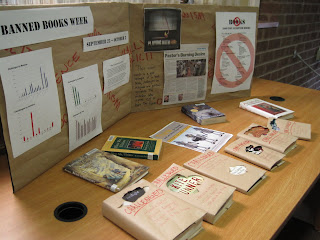 algebra or balance a checkbook until they're legally adults; those are important, yes, but we at the Library also offer a place where people are free to investigate any line of questioning they wish.
That's why Banned Books Week is relevant to the Gallaudet University Library, even though very few, if any, of our books are actually challenged; this is true for most other academic libraries. To learn more about Banned Books Week at the Gallaudet University Library, come in and look at the display table in front of the first-floor entrance by Peet Hall, where Elizabeth Henry's set up a fantastic display of banned books.
Heck, take one home with you if you like.
No, it's not a national holiday. It's actually sort of an awareness campaign that the American Library Association sponsors every year.
Awareness of what, you ask? Of things like the following list of titles:
1. ttyl; ttfn; l8r, g8r (series), by Lauren Myracle
2. And Tango Makes Three, by Peter Parnell and Justin Richardson
3. The Perks of Being A Wallflower, by Stephen Chbosky
4. To Kill A Mockingbird, by Harper Lee
5. Twilight (series) by Stephenie Meyer
6. Catcher in the Rye, by J.D. Salinger
7. My Sister’s Keeper, by Jodi Picoult
8. The Earth, My Butt, and Other Big, Round Things, by Carolyn Mackler
9. The Color Purple, by Alice Walker
10. The Chocolate War, by Robert Cormier
And so things become a bit clearer: These books are, in fact, the top ten most-challenged books of 2009.
It sounds kind of funny: what does "challenging" mean, anyway? What does this have to do with banned books?
A lot, in fact. "Challenge" is a word used to describe the process of requesting that a library remove a book from its shelves for various reasons unrelated to the book's physical condition or currency (how up-to-date it is). In other words, these are books that people want banned -- and these books got the most requests for removal out of all challenged books in the United States last year.
Still sounds kind of vague, huh? After all, look at the list again. And Tango Makes Three? That's a children's book about penguins! The Perks of Being a Wallflower? It's practically a Bible for adolescents and college students who don't quite fit in. To Kill a Mockingbird -- that's a classic! Ditto Catcher in the Rye. My Sister's Keeper kind of makes sense; I've heard that it makes people cry. But The Color Purple? That's another significant classic in 20th-Century American literature.
That's just from the 2009 list. Check out this list of classics that have been banned or challenged at one time or another; there are some real eye-poppers in there, like Winnie-the-Pooh.
Why are they challenged? Luckily, ALA keeps track of the reasons, as reported to the Office for Intellectual Freedom. Here's the same list again, this time with the reasons for each challenge:
1. ttyl; ttfn; l8r, g8r (series), by Lauren Myracle
Reasons: drugs, nudity, offensive language, sexually explicit, unsuited to age group
2. And Tango Makes Three, by Peter Parnell and Justin Richardson
Reasons: homosexuality
3. The Perks of Being A Wallflower, by Stephen Chbosky
Reasons: anti-family, drugs, homosexuality, offensive language, religious viewpoint, sexually explicit, suicide, unsuited to age group
4. To Kill A Mockingbird, by Harper Lee
Reasons: offensive language, racism, unsuited to age group
5. Twilight (series) by Stephenie Meyer
Reasons: religious viewpoint, sexually explicit, unsuited to age group
6. Catcher in the Rye, by J.D. Salinger
Reasons: offensive language, sexually explicit, unsuited to age group
7. My Sister’s Keeper, by Jodi Picoult
Reasons: homosexuality, offensive language, religious viewpoint, sexism, sexually explicit, unsuited to age group, violence
8. The Earth, My Butt, and Other Big, Round Things, by Carolyn Mackler
Reasons: offensive language, sexually explicit, unsuited to age group
9. The Color Purple, by Alice Walker
Reasons: offensive language, sexually explicit, unsuited to age group
10. The Chocolate War, by Robert Cormier
Reasons: nudity, offensive language, sexually explicit, unsuited to age group
So someone doesn't like And Tango Makes Three because it's about a pair of male penguins who raise a child, which might touch on a topic he or she feels is not appropriate for the children who would read it. What happens?
Usually, they go to their library and ask that the library stop making that book available, through means that vary from library to library -- some have forms you can fill out, while others just write down the book title and take it to the person or committee who's responsible for making decisions about challenged books. Then that decision-making entity figures out how to respond to the complaint: Should the book be moved to a more appropriate section? Should we remove it entirely? Or should we do nothing?
Although I don't have statistics immediately to hand, I assume that in the majority of cases, the decision is to do nothing. If you've read even two or three of the books in that list above, you understand why. Yes, all of these complaints are true, but are they reasons to censor these books?
You may have hesitated before answering that last question for yourself. That hesitation is what makes life interesting for some librarians; there's no universal rule that says "This book MUST be removed from shelves if ... " Some libraries toss those complaints right into the trash; it's not their job to control what people can or can't read, regardless of age -- they just make the books available, and the rest is up to the readers. Other libraries rely on their own rules, like "gratuitousness" -- is this violence, language, or sexuality excessive? "Excessive" in whose opinion? Is it one of those things that you'll know when you see it, or is excessive violence quantifiable? How do you justify those kinds of decisions? Still others do pay attention to age-appropriateness; The Chocolate War sounds like a kids' book and might be in the library's catalog as such, but it is most definitely better-suited to teenagers. The gray areas go on and on ...
We don't do this because we think we know better than the people making the requests to remove books; all of this matters, because books that have been banned on moral, philosophical, religious, or political grounds are books that have been censored. Censorship is a bad thing; the First Amendment guarantees the right to express your opinion, and librarians play one of the most important supporting roles for this basic human right in our society. The flipside of the freedom of speech is the freedom to read, something that ALA strongly supports; not only do you have the right to express your opinion, you have the right to gain access to the printed opinions of others. This is called intellectual freedom, the freedom to ask questions and gain answers, and it's one of the most fundamental concepts underlying the establishment of a university. Universities don't just teach high-school kids how to do linear
 algebra or balance a checkbook until they're legally adults; those are important, yes, but we at the Library also offer a place where people are free to investigate any line of questioning they wish.
That's why Banned Books Week is relevant to the Gallaudet University Library, even though very few, if any, of our books are actually challenged; this is true for most other academic libraries. To learn more about Banned Books Week at the Gallaudet University Library, come in and look at the display table in front of the first-floor entrance by Peet Hall, where Elizabeth Henry's set up a fantastic display of banned books.
Heck, take one home with you if you like.
Friday, June 18, 2010
What's hiding in our collection?
This past week, I committed a grave sin. I've done it before, but often for reasons having to do figuring out how to best expand the collection. This time, though, I just wanted to read it and we didn't have the book, so I ...
Well, I ... I ordered it from another university.
Okay, I'm kidding. Truth is, the availability of so many books from so many good universities is one of the Gallaudet University Library's many benefits, and I feel no real shame in taking full advantage of it. In this case, it was Perfectly Reasonable Deviations, a collection of Richard Feynman's personal letters, edited by his daughter.
If you don't know who Richard Feynman (pronounced FINE-man) is, shame on you. He was one of the most significant and well-respected physicists of his time, which actually comprised the majority of the 20th Century -- he was born in 1918 and died in 1988. He started out fairly young, earning his doctorate at Princeton and working at Los Alamos in his 20s, helping the military figure out how to build an atomic bomb during World War II, then moved on to figuring out the fundamentals of several very important aspects of quantum physics. He went on to become one of Caltech's most popular teachers, won a Nobel Prize for some of his work in 1965, and was one of the investigators of the Space Shuttle Challenger disaster in 1986.
It all sounds relatively pedestrian until you dig into the details of his life, which Perfectly Reasonable Deviations lets you do. For instance, he was also a widely-known bongo player. Mad about bongos, actually. He played them all over the world and once joked that people knew him better for his drumming than his physics. He had two great loves of his life; his first wife died in the 1940s of tuberculosis while he was working at Los Alamos, and he met (and married) his second wife on the spur of the moment in the 1960s and she was with him when he died in 1988, just shy of 70 years old. In the twenty years that separated both wives, though, it is said that he was very popular with the young ladies.
This might sound odd to you, but he was also one of the first scientist-celebrities. Albert Einstein made headlines, but this guy made movies. His Lectures on Physics sold millions of copies on tape and in print, and he had his own television miniseries, where he just stood there and talked about physics. People ate it up; he was a brilliant and engaging teacher who was able to explain some of the most exotic concepts known to modern science (at that time, anyway) to complete laymen. He was the first Carl Sagan, Michio Kaku, and Neil deGrasse Tyson in terms of his recognizability, though much closer to Stephen Hawking in his contributions to quantum physics.
He also had a bit of a Mr. Wizard sensibility; he demonstrated to a Congressional hearing that the Challenger disaster was due in large part to frozen O-rings failing to protect the Shuttle from the superheated gases propelling it upward. How? By dropping a piece of O-ring material in a Styrofoam cup of ice water, then showing how the cold temperature made the O-ring return to its proper shape much more slowly than it should have, a vital characteristic when you don't want multibillion-dollar spacecraft exploding and people dying.
Perfectly Reasonable Deviations emphasizes his popular appeal quite a bit; it includes dozens of fan letters from a wide range of people, from car mechanics to British housewives, all thanking him for making it all perfectly clear to them and asking him questions one wouldn't expect to hear outside of a graduate-level physics course.
Of course, the larger message of Perfectly Reasonable Deviations is subtle: Although Feynman became busier and busier and more and more famous over the fifty-year period covered in the book, he answered almost every single letter personally, albeit occasionally with apologies for taking so much time to respond. His responses nevertheless show that he took the time to read them, think about them, and do his best to answer any questions that came up. And they certainly came up; he responded to questions about anything from the quirks of particle behavior to a father's worries about his science-loving son. The overall impression is one of a very smart, very funny guy who treated complete strangers with the utmost grace.
It's highly recommended if you're curious about the life and mind of one of modern science's seminal figures. No lab-coat-bedecked geek here!
And now, as another brilliant 20th-Century mind once said, on with the opera.
Did you know that Gallaudet University has had a library since 1864? We'll be celebrating our 150th birthday in 2014. One of the biggest advantages of our longevity is that we've had time to collect some truly interesting items, including the occasional 19th-Century specimen.
Those older books can be pretty fragile, though; we do have plenty of cool stuff dating from 1950 up to now. Let's take a look, starting with the magical stuff (literally) and moving to the just plain interesting:
A History of Magic and Experimental Science
This one kind of breaks the rule -- the first volume was published in 1923, but the last was published in 1958. The title constitutes an interesting juxtaposition, doesn't it? In general, this series of historical investigations covers the transition from superstition and magical thinking to the scientific method, starting with the Roman Empire (Volume 1, The first thirteen centuries of our era) and ending with the dawning of the Age of Enlightenment (Volume 8, The seventeenth century). It's a fascinating look at the history of our civilization and the foundations of the rationalism so venerated in some circles today.
The Magician, the Witch, and the Law
Another historical tome, this one focuses more specifically on medieval witchcraft and the effect it had on society and the legal code -- such as it was in a feudal age. It examines how magic in general influenced public thinking, analyzing public discourse and how leaders took advantage of the superstitious to achieve their own ends -- and how the witches and magicians of the time took advantage of this same credulity to achieve their own. It also goes into some detail about how medieval witchery clashed with the Inquisition and the tragic results.
Magic: A Reference Guide
Because I am hilarious like that, we'll wrap up the conjuration with a book on prestidigitation: stage magic. This book is a terrific look into how something that may appear on stage to be utterly unexplainable is actually totally rational; it's all a matter of manipulating objects, the audience, and the situation. It's a fascinating read!
How to Enjoy Ballet
I have no real interest in ballet or learning how to enjoy it, but isn't the title great? In all seriousness, ballet is one of the most difficult forms of dancing; it's highly reliant on a combination of technically-adept execution and aesthetic appeal. Not only are there specific moves, foot placements, and arm positions, but a dancer needs to be able to follow the music and transition from one position to another as smoothly and elegantly as possible. Like figure-skating, it's a much-misunderstood but extremely complex form of expression, and some people need help understanding it. This book is a great place to start!
Contemporary Hermeneutics
It's not the most welcoming of titles, I agree; "hermeneutics" is generally defined as the science of exegesis, particularly of spiritual writings. In this book, though, it's placed in an architectural context on a continuum from Pre-Classicism all the way up to Ecoism. It discusses how buildings are interpreted, often in terms of the prevailing beliefs of the time. For example, Thomas Jefferson's mansion in Virginia, Monticello, was designed in the Palladian tradition, which was heavily reliant on geometry, symmetry, and the designs of ancient Greek temples. That one of our founding fathers chose to build a house that resembled, in some ways, a three-thousand-year-old temple suggests that he saw some essential similarities between ancient Greek society and the civilization he was trying to build. It's a very fascinating book, especially when you get up into the incredible mishmash of architectural philosophies represented by early-20th-Century New York.
Soviet Economic Progress: Because of, or in Spite of, the Government
Part of the reason I find this book interesting is the perception I have of US-USSR relations around 1957, when this book was published. It just feels as though both countries were completely closed off to one another, their motives inscrutable to us, ours untrustworthy to them. Intellectually, though -- and partly because of this book -- I understand that that simply wasn't true. In fact, in Perfectly Reasonable Deviations, reviewed above, there are several letters between Dr. Feynman and the Soviets as he repeatedly declines their invitations to participate in a symposium in Leningrad. There was plenty of information exchange between both countries, regardless of how hostile both governments were toward one another.
After Hamelin
This one's a lot newer; published in 2000, it's a novel about an old woman who tells a story about the Pied Piper of Hamelin. If you're not familiar with the story, the town of Hamelin had a serious rat problem, and they hired the Pied Piper to use his magical pipe to lure all the rats away. However, when he was done, the town refused to pay him, so in revenge, he pulled out his pipe and took all the children away, and they were never seen again. That's the basic story as most people know it; in After Hamelin, the old woman reveals a new fact: one child stayed behind. The Pied Piper couldn't lure her away because she was deaf! Terrific book.
Face Reading
This is a cool book! It relies on the art of physiognomy: determining aspects of personality based on one's facial shape and features. It's an ancient Chinese art (one of many, it sometimes seems) known as siang mien. Your ears can predict your future (how does that work for deaf people, I wonder ... ), and various facial features can impute information about one's sexuality, success in relationships, and the outcome of each year of a person's life. There's some bona-fide medical stuff in there too: some diseases are indicated, first and foremost, by changes in facial characteristics, like the loss of eyebrow hair, changes in the shape of the nose, lip coloration, and the structure of the eye.
I think we'll stop here -- it's an interesting mishmash of stuff I've dug up. There are many more books like these throughout the collection; an hour's worth of browsing can yield some serious serendipity if you're after the weird and offbeat.
As a reminder: Next week, no post. I'll be at the big, giant ALA conference. The following week, you'll get an on-the-ground report from your friendly neighborhood librarian!
Question of the Week
The Library printer I was using jammed! What do I do?
The first thing you should do is tell the person who's working at the Service Desk so he or she can fix it. If you're really pressed for time, you can also switch to the other printer. That's why we have two; sometimes things don't work quite right with one, so we have the other one as a backup.
Well, I ... I ordered it from another university.
Okay, I'm kidding. Truth is, the availability of so many books from so many good universities is one of the Gallaudet University Library's many benefits, and I feel no real shame in taking full advantage of it. In this case, it was Perfectly Reasonable Deviations, a collection of Richard Feynman's personal letters, edited by his daughter.
If you don't know who Richard Feynman (pronounced FINE-man) is, shame on you. He was one of the most significant and well-respected physicists of his time, which actually comprised the majority of the 20th Century -- he was born in 1918 and died in 1988. He started out fairly young, earning his doctorate at Princeton and working at Los Alamos in his 20s, helping the military figure out how to build an atomic bomb during World War II, then moved on to figuring out the fundamentals of several very important aspects of quantum physics. He went on to become one of Caltech's most popular teachers, won a Nobel Prize for some of his work in 1965, and was one of the investigators of the Space Shuttle Challenger disaster in 1986.
It all sounds relatively pedestrian until you dig into the details of his life, which Perfectly Reasonable Deviations lets you do. For instance, he was also a widely-known bongo player. Mad about bongos, actually. He played them all over the world and once joked that people knew him better for his drumming than his physics. He had two great loves of his life; his first wife died in the 1940s of tuberculosis while he was working at Los Alamos, and he met (and married) his second wife on the spur of the moment in the 1960s and she was with him when he died in 1988, just shy of 70 years old. In the twenty years that separated both wives, though, it is said that he was very popular with the young ladies.
This might sound odd to you, but he was also one of the first scientist-celebrities. Albert Einstein made headlines, but this guy made movies. His Lectures on Physics sold millions of copies on tape and in print, and he had his own television miniseries, where he just stood there and talked about physics. People ate it up; he was a brilliant and engaging teacher who was able to explain some of the most exotic concepts known to modern science (at that time, anyway) to complete laymen. He was the first Carl Sagan, Michio Kaku, and Neil deGrasse Tyson in terms of his recognizability, though much closer to Stephen Hawking in his contributions to quantum physics.
He also had a bit of a Mr. Wizard sensibility; he demonstrated to a Congressional hearing that the Challenger disaster was due in large part to frozen O-rings failing to protect the Shuttle from the superheated gases propelling it upward. How? By dropping a piece of O-ring material in a Styrofoam cup of ice water, then showing how the cold temperature made the O-ring return to its proper shape much more slowly than it should have, a vital characteristic when you don't want multibillion-dollar spacecraft exploding and people dying.
Perfectly Reasonable Deviations emphasizes his popular appeal quite a bit; it includes dozens of fan letters from a wide range of people, from car mechanics to British housewives, all thanking him for making it all perfectly clear to them and asking him questions one wouldn't expect to hear outside of a graduate-level physics course.
Of course, the larger message of Perfectly Reasonable Deviations is subtle: Although Feynman became busier and busier and more and more famous over the fifty-year period covered in the book, he answered almost every single letter personally, albeit occasionally with apologies for taking so much time to respond. His responses nevertheless show that he took the time to read them, think about them, and do his best to answer any questions that came up. And they certainly came up; he responded to questions about anything from the quirks of particle behavior to a father's worries about his science-loving son. The overall impression is one of a very smart, very funny guy who treated complete strangers with the utmost grace.
It's highly recommended if you're curious about the life and mind of one of modern science's seminal figures. No lab-coat-bedecked geek here!
And now, as another brilliant 20th-Century mind once said, on with the opera.
Did you know that Gallaudet University has had a library since 1864? We'll be celebrating our 150th birthday in 2014. One of the biggest advantages of our longevity is that we've had time to collect some truly interesting items, including the occasional 19th-Century specimen.
Those older books can be pretty fragile, though; we do have plenty of cool stuff dating from 1950 up to now. Let's take a look, starting with the magical stuff (literally) and moving to the just plain interesting:
A History of Magic and Experimental Science
This one kind of breaks the rule -- the first volume was published in 1923, but the last was published in 1958. The title constitutes an interesting juxtaposition, doesn't it? In general, this series of historical investigations covers the transition from superstition and magical thinking to the scientific method, starting with the Roman Empire (Volume 1, The first thirteen centuries of our era) and ending with the dawning of the Age of Enlightenment (Volume 8, The seventeenth century). It's a fascinating look at the history of our civilization and the foundations of the rationalism so venerated in some circles today.
The Magician, the Witch, and the Law
Another historical tome, this one focuses more specifically on medieval witchcraft and the effect it had on society and the legal code -- such as it was in a feudal age. It examines how magic in general influenced public thinking, analyzing public discourse and how leaders took advantage of the superstitious to achieve their own ends -- and how the witches and magicians of the time took advantage of this same credulity to achieve their own. It also goes into some detail about how medieval witchery clashed with the Inquisition and the tragic results.
Magic: A Reference Guide
Because I am hilarious like that, we'll wrap up the conjuration with a book on prestidigitation: stage magic. This book is a terrific look into how something that may appear on stage to be utterly unexplainable is actually totally rational; it's all a matter of manipulating objects, the audience, and the situation. It's a fascinating read!
How to Enjoy Ballet
I have no real interest in ballet or learning how to enjoy it, but isn't the title great? In all seriousness, ballet is one of the most difficult forms of dancing; it's highly reliant on a combination of technically-adept execution and aesthetic appeal. Not only are there specific moves, foot placements, and arm positions, but a dancer needs to be able to follow the music and transition from one position to another as smoothly and elegantly as possible. Like figure-skating, it's a much-misunderstood but extremely complex form of expression, and some people need help understanding it. This book is a great place to start!
Contemporary Hermeneutics
It's not the most welcoming of titles, I agree; "hermeneutics" is generally defined as the science of exegesis, particularly of spiritual writings. In this book, though, it's placed in an architectural context on a continuum from Pre-Classicism all the way up to Ecoism. It discusses how buildings are interpreted, often in terms of the prevailing beliefs of the time. For example, Thomas Jefferson's mansion in Virginia, Monticello, was designed in the Palladian tradition, which was heavily reliant on geometry, symmetry, and the designs of ancient Greek temples. That one of our founding fathers chose to build a house that resembled, in some ways, a three-thousand-year-old temple suggests that he saw some essential similarities between ancient Greek society and the civilization he was trying to build. It's a very fascinating book, especially when you get up into the incredible mishmash of architectural philosophies represented by early-20th-Century New York.
Soviet Economic Progress: Because of, or in Spite of, the Government
Part of the reason I find this book interesting is the perception I have of US-USSR relations around 1957, when this book was published. It just feels as though both countries were completely closed off to one another, their motives inscrutable to us, ours untrustworthy to them. Intellectually, though -- and partly because of this book -- I understand that that simply wasn't true. In fact, in Perfectly Reasonable Deviations, reviewed above, there are several letters between Dr. Feynman and the Soviets as he repeatedly declines their invitations to participate in a symposium in Leningrad. There was plenty of information exchange between both countries, regardless of how hostile both governments were toward one another.
After Hamelin
This one's a lot newer; published in 2000, it's a novel about an old woman who tells a story about the Pied Piper of Hamelin. If you're not familiar with the story, the town of Hamelin had a serious rat problem, and they hired the Pied Piper to use his magical pipe to lure all the rats away. However, when he was done, the town refused to pay him, so in revenge, he pulled out his pipe and took all the children away, and they were never seen again. That's the basic story as most people know it; in After Hamelin, the old woman reveals a new fact: one child stayed behind. The Pied Piper couldn't lure her away because she was deaf! Terrific book.
Face Reading
This is a cool book! It relies on the art of physiognomy: determining aspects of personality based on one's facial shape and features. It's an ancient Chinese art (one of many, it sometimes seems) known as siang mien. Your ears can predict your future (how does that work for deaf people, I wonder ... ), and various facial features can impute information about one's sexuality, success in relationships, and the outcome of each year of a person's life. There's some bona-fide medical stuff in there too: some diseases are indicated, first and foremost, by changes in facial characteristics, like the loss of eyebrow hair, changes in the shape of the nose, lip coloration, and the structure of the eye.
I think we'll stop here -- it's an interesting mishmash of stuff I've dug up. There are many more books like these throughout the collection; an hour's worth of browsing can yield some serious serendipity if you're after the weird and offbeat.
As a reminder: Next week, no post. I'll be at the big, giant ALA conference. The following week, you'll get an on-the-ground report from your friendly neighborhood librarian!
Question of the Week
The Library printer I was using jammed! What do I do?
The first thing you should do is tell the person who's working at the Service Desk so he or she can fix it. If you're really pressed for time, you can also switch to the other printer. That's why we have two; sometimes things don't work quite right with one, so we have the other one as a backup.
Friday, June 11, 2010
New fiction
And our summer marches on!
I've been curious about Joe Hill's books for a few months now, so I checked out The Heart-Shaped Box and Horns and clipped through them in a single weekend; they're that quick and easy to read. They aren't small books, though -- they're full-fledged novels with really terrific characters and absorbing plots.
The Heart-Shaped Box was essentially Hill's debut novel, and it made major waves when it came out last year. This is because it's supremely creepy and doesn't spare any ultraviolence. An aging rock star named Judas Coyne -- a combination of Elvis, Mick Jagger, Ozzy Osbourne, and anyone from ZZ Top -- is a gothy sort who lives with a young lady half his age in a farmhouse somewhere in New York. He collects creepy things, like a human skull belonging to someone who was trepanned (a process where a hole is drilled in the skull of a live person to cure ills -- not as widely practiced these days), coffins, and a dead man's suit.
The dead man's suit, in particular, is the basic premise of the novel. The rock star's assistant gets an e-mail telling him about the suit, which is up for auction online, and of course, Coyne can't resist, especially when he finds out that there's a ghost attached.
Unfortunately, it turns out to be true. And it's done in a disturbing way that still makes me nervous. The night after he gets the suit (wrapped in a heart-shaped box, hence the title), he wakes up in the middle of the night, thinking he heard something. He walks down the hall, past an old man sitting in a rocking chair, goes downstairs and looks around a little bit, but nothing's out of order. He goes back up the stairs, walks past the old man sitting in the rocking chair, and goes into his room. Then something strikes him as odd, and he looks back into the hall, which has become very cold, but there's nothing -- and nobody -- there. And so it begins ...
Horns is a little more straightforward. It's less creepy and more of a surrealist revenge fantasy. This guy goes on a major bender, completely blacks out a full night, and wakes up the next morning in his own bed, much the worse for wear. He goes into the bathroom, glances at himself in the mirror, and discovers that he's grown a pair of small horns for no apparent reason. He discovers a few new talents he's picked up with the horns: first, nobody notices that he has horns -- and they always forget he was ever there after the conversation ends. Second, when he talks to people, the horns make them confess all of their most secret sins, and he can make them do things. Third, when he touches someone, he picks up their entire past, including some of the darkest things they've ever done. And snakes really, really like him.
Of course, I still haven't mentioned the most important part, other than the horns: His girlfriend was violently murdered a year previously, and he's the main suspect. All the evidence that might have cleared his name was destroyed in a mysterious fire, and his girlfriend was beloved by their hometown, so he's nearly universally hated. I was expecting this to be almost a mystery, the main character spending most of the novel trying to find the killer's name and then facing off with him in an apocalyptic showdown. However, he discovers the real murderer's name within the first couple of chapters, and the rest of the novel is concerned chiefly with hunting down and cornering the killer and exacting vengeance. All throughout the book, the horns keep growing and his skin begins to change ...
Well, read the book. It's a fantastic read, possibly (slightly) better than The Heart-Shaped Box.
Anyway,I've spent most of this week locked up in my office working on stuff, which I will explain more about later in the summer, I promise. I've also been planning for the American Library Association's big, giant annual conference, which is here in DC in a couple of weeks. I'm excited; I've been a bona-fide librarian for two years now and I'm finally going to the conference. I'll skip that week's post (Friday, June 25) and report to you all the following week! In the meantime, here's a list of fun new fiction that's come in over the last couple months to hold you over until I can focus on something more substantive!
The Infinities
A most decidedly unusual book, this novel tells the story of a dying mathematician (hence, the title -- partly) and his family, who are holding vigil over him on a hot summer afternoon. However, his family is not alone in participating in the end of his life; all around them are little gods, in the classical Greek sense (the other part of the title's meaning), who move around and through the family seen and unseen and wickedly stir up a seething cauldron of trouble.
Portrait of the Writer as a Domesticated Animal
The title takes things a bit literally; the author/narrator spends some time with the Hamburger King, one of the most influential businessmen on the planet, while he machinates his way through his empire, subordinates, friends, and relatives. Funny, eccentric, and highly satirical, this novel, translated from French, sort of makes you think about all the ways in which we all endure servitude and even, in some cases, enjoy it.
Beatrice and Virgil
Yann Martel, author of the bestselling Life of Pi, brings us another animal-themed novel; Beatrice, a donkey, and Virgil, a howler monkey, are the centers of a play-within-a-novel written by a taxidermist. The main character is an author who seems rather similar to Martel, sucked into the taxidermist's bizarre inner life as he assists in writing the play.
Let the Great World Spin
The 1974 feat of Philippe Petit, a French tightrope walker who walked between the towers of the World Trade Center, 110 stories up, becomes the focal point of several different Manhattan stories that intersect at the end of the novel. It's one of those books, but the author pulls it off with such grace you're guaranteed to be thinking about it for weeks afterward.
The November Criminals
This novel pulls off the triple distinction of being a funny stoner novel set in DC. A small-time drug dealer in high school decides to investigate his classmate's murder, but he has a weakness for his own product, which throws a few wrenches in his clever, clever plan. The book can be a little hard to follow, but that's just because the main character is stoned all the time, so is easily distracted by interesting tangents.
Dog Boy
One of those fascinating feral-child stories, a young Russian boy is abandoned by his mother, and he falls in with a pack of stray dogs, which enables him to survive for another two years. The author follows his progress from the hairless outsider of the pack to a trusted alpha dog until his capture by a scientist who hopes to make his name based on the young boy's life. Strange, but it's a wonderful read and avoids the drippy sentimentality one sometimes gets from boy-and-his-dog stories.
The Last Surgeon
A hospital thriller, this novel takes everyone in the operating room during a nastily-botched surgery and kills them off one by one. The survivors -- a nurse, a physician, and the last remaining surgeon -- have to team up and hunt down a hired killer who has a singular talent for making a murder resemble a suicide. Taut and suspenseful, this makes for great light reading.
The Sheen on the Silk
A fascinating historical novel that takes place in the late-13th-Century Byzantine Empire, this book follows Anna, who must investigate the circumstances under which her twin brother was exiled. He's innocent, but is the center of a mysterious conspiracy; Anna dresses up as a eunuch and spends much of the book maneuvering herself closer and closer to the central figures of the story.
Wench
Another historical novel, this one is set in antebellum America, at a resort in Ohio known for its clientele of rich white slave-owners with their slave-mistresses. The novel follows three women who are regulars at the resort and the upheaval in their lives following the arrival of a fourth, who does not hold back from wondering about freedom. That the resort is in Ohio, a free state, complicates matters, as does the fact that one of the slaves is in love with her master and thinks the feeling is mutual. It's a complicated, psychological book.
The Book of Spies
Ivan the Terrible is a legendary figure in Russian -- and indeed global -- history. What few people know is that he was an avid collector of books, one of many characteristics I share with him. Unfortunately, his collection was lost, and since he owned many rare, one-of-a-kind books, those stories were lost as well. Now they've begun to emerge, and are at the center of a sort of worldwide book club composed of a cabal of incredibly wealthy men. Then the CIA finds a link to a bank account associated with terrorism and gets involved ...
That takes care of this week. We got a fantastically good crop of books this year, and I'm very pleased with the results. Next week, we'll take a look at the rest of the collection and some of the more unusual books we have here.
Question of the Week
I saw a bunch of librarians cleaning out the VHS shelves. What's going on? Are you getting rid of all the movies?
We're clearing out the VHS shelves, but we're not getting rid of all the movies, just many of the videotapes. Part of it is because those things are old, rarely checked out, and obsolete. Most of them have degraded significantly since they arrived -- normal for VHS tapes -- and because the format is so outdated, most people end up watching them here in the Library, where there are still VCRs. Another part is just that our collection of Deaf DVDs is expanding, and they need room! That's the life of a library -- over time, some things elbow their way in and other things get pushed out. We're not getting rid of stuff, we're making room for new things. It's been an exciting summer so far!
I've been curious about Joe Hill's books for a few months now, so I checked out The Heart-Shaped Box and Horns and clipped through them in a single weekend; they're that quick and easy to read. They aren't small books, though -- they're full-fledged novels with really terrific characters and absorbing plots.
The Heart-Shaped Box was essentially Hill's debut novel, and it made major waves when it came out last year. This is because it's supremely creepy and doesn't spare any ultraviolence. An aging rock star named Judas Coyne -- a combination of Elvis, Mick Jagger, Ozzy Osbourne, and anyone from ZZ Top -- is a gothy sort who lives with a young lady half his age in a farmhouse somewhere in New York. He collects creepy things, like a human skull belonging to someone who was trepanned (a process where a hole is drilled in the skull of a live person to cure ills -- not as widely practiced these days), coffins, and a dead man's suit.
The dead man's suit, in particular, is the basic premise of the novel. The rock star's assistant gets an e-mail telling him about the suit, which is up for auction online, and of course, Coyne can't resist, especially when he finds out that there's a ghost attached.
Unfortunately, it turns out to be true. And it's done in a disturbing way that still makes me nervous. The night after he gets the suit (wrapped in a heart-shaped box, hence the title), he wakes up in the middle of the night, thinking he heard something. He walks down the hall, past an old man sitting in a rocking chair, goes downstairs and looks around a little bit, but nothing's out of order. He goes back up the stairs, walks past the old man sitting in the rocking chair, and goes into his room. Then something strikes him as odd, and he looks back into the hall, which has become very cold, but there's nothing -- and nobody -- there. And so it begins ...
Horns is a little more straightforward. It's less creepy and more of a surrealist revenge fantasy. This guy goes on a major bender, completely blacks out a full night, and wakes up the next morning in his own bed, much the worse for wear. He goes into the bathroom, glances at himself in the mirror, and discovers that he's grown a pair of small horns for no apparent reason. He discovers a few new talents he's picked up with the horns: first, nobody notices that he has horns -- and they always forget he was ever there after the conversation ends. Second, when he talks to people, the horns make them confess all of their most secret sins, and he can make them do things. Third, when he touches someone, he picks up their entire past, including some of the darkest things they've ever done. And snakes really, really like him.
Of course, I still haven't mentioned the most important part, other than the horns: His girlfriend was violently murdered a year previously, and he's the main suspect. All the evidence that might have cleared his name was destroyed in a mysterious fire, and his girlfriend was beloved by their hometown, so he's nearly universally hated. I was expecting this to be almost a mystery, the main character spending most of the novel trying to find the killer's name and then facing off with him in an apocalyptic showdown. However, he discovers the real murderer's name within the first couple of chapters, and the rest of the novel is concerned chiefly with hunting down and cornering the killer and exacting vengeance. All throughout the book, the horns keep growing and his skin begins to change ...
Well, read the book. It's a fantastic read, possibly (slightly) better than The Heart-Shaped Box.
Anyway,I've spent most of this week locked up in my office working on stuff, which I will explain more about later in the summer, I promise. I've also been planning for the American Library Association's big, giant annual conference, which is here in DC in a couple of weeks. I'm excited; I've been a bona-fide librarian for two years now and I'm finally going to the conference. I'll skip that week's post (Friday, June 25) and report to you all the following week! In the meantime, here's a list of fun new fiction that's come in over the last couple months to hold you over until I can focus on something more substantive!
The Infinities
A most decidedly unusual book, this novel tells the story of a dying mathematician (hence, the title -- partly) and his family, who are holding vigil over him on a hot summer afternoon. However, his family is not alone in participating in the end of his life; all around them are little gods, in the classical Greek sense (the other part of the title's meaning), who move around and through the family seen and unseen and wickedly stir up a seething cauldron of trouble.
Portrait of the Writer as a Domesticated Animal
The title takes things a bit literally; the author/narrator spends some time with the Hamburger King, one of the most influential businessmen on the planet, while he machinates his way through his empire, subordinates, friends, and relatives. Funny, eccentric, and highly satirical, this novel, translated from French, sort of makes you think about all the ways in which we all endure servitude and even, in some cases, enjoy it.
Beatrice and Virgil
Yann Martel, author of the bestselling Life of Pi, brings us another animal-themed novel; Beatrice, a donkey, and Virgil, a howler monkey, are the centers of a play-within-a-novel written by a taxidermist. The main character is an author who seems rather similar to Martel, sucked into the taxidermist's bizarre inner life as he assists in writing the play.
Let the Great World Spin
The 1974 feat of Philippe Petit, a French tightrope walker who walked between the towers of the World Trade Center, 110 stories up, becomes the focal point of several different Manhattan stories that intersect at the end of the novel. It's one of those books, but the author pulls it off with such grace you're guaranteed to be thinking about it for weeks afterward.
The November Criminals
This novel pulls off the triple distinction of being a funny stoner novel set in DC. A small-time drug dealer in high school decides to investigate his classmate's murder, but he has a weakness for his own product, which throws a few wrenches in his clever, clever plan. The book can be a little hard to follow, but that's just because the main character is stoned all the time, so is easily distracted by interesting tangents.
Dog Boy
One of those fascinating feral-child stories, a young Russian boy is abandoned by his mother, and he falls in with a pack of stray dogs, which enables him to survive for another two years. The author follows his progress from the hairless outsider of the pack to a trusted alpha dog until his capture by a scientist who hopes to make his name based on the young boy's life. Strange, but it's a wonderful read and avoids the drippy sentimentality one sometimes gets from boy-and-his-dog stories.
The Last Surgeon
A hospital thriller, this novel takes everyone in the operating room during a nastily-botched surgery and kills them off one by one. The survivors -- a nurse, a physician, and the last remaining surgeon -- have to team up and hunt down a hired killer who has a singular talent for making a murder resemble a suicide. Taut and suspenseful, this makes for great light reading.
The Sheen on the Silk
A fascinating historical novel that takes place in the late-13th-Century Byzantine Empire, this book follows Anna, who must investigate the circumstances under which her twin brother was exiled. He's innocent, but is the center of a mysterious conspiracy; Anna dresses up as a eunuch and spends much of the book maneuvering herself closer and closer to the central figures of the story.
Wench
Another historical novel, this one is set in antebellum America, at a resort in Ohio known for its clientele of rich white slave-owners with their slave-mistresses. The novel follows three women who are regulars at the resort and the upheaval in their lives following the arrival of a fourth, who does not hold back from wondering about freedom. That the resort is in Ohio, a free state, complicates matters, as does the fact that one of the slaves is in love with her master and thinks the feeling is mutual. It's a complicated, psychological book.
The Book of Spies
Ivan the Terrible is a legendary figure in Russian -- and indeed global -- history. What few people know is that he was an avid collector of books, one of many characteristics I share with him. Unfortunately, his collection was lost, and since he owned many rare, one-of-a-kind books, those stories were lost as well. Now they've begun to emerge, and are at the center of a sort of worldwide book club composed of a cabal of incredibly wealthy men. Then the CIA finds a link to a bank account associated with terrorism and gets involved ...
That takes care of this week. We got a fantastically good crop of books this year, and I'm very pleased with the results. Next week, we'll take a look at the rest of the collection and some of the more unusual books we have here.
Question of the Week
I saw a bunch of librarians cleaning out the VHS shelves. What's going on? Are you getting rid of all the movies?
We're clearing out the VHS shelves, but we're not getting rid of all the movies, just many of the videotapes. Part of it is because those things are old, rarely checked out, and obsolete. Most of them have degraded significantly since they arrived -- normal for VHS tapes -- and because the format is so outdated, most people end up watching them here in the Library, where there are still VCRs. Another part is just that our collection of Deaf DVDs is expanding, and they need room! That's the life of a library -- over time, some things elbow their way in and other things get pushed out. We're not getting rid of stuff, we're making room for new things. It's been an exciting summer so far!
Friday, June 4, 2010
An introduction to our e-books
Summer has arrived, hot and steamy! I remember a month ago, when the temperature just would not rise, wishing things'd heat up a little. Well, I got my wish, and in spades. It's barely June, and already I'm thinking about snow and how it maybe isn't so bad after all.
Haha! I'm kidding! Forget snow.
Let's jump right in. I finished up Tom Wolfe's Bonfire of the Vanities this past week because I bought a book based on his work -- Tom Wolfe's America: Heroes, Pranksters, and Fools -- and it piqued my curiosity. Bonfire seemed pretty well-thumbed through, and it's one of those titles you're always hearing about, thinking it's something by Maugham or, yes, even Woolf, maybe mid-century or even further back.
Bonfire's actually set in Manhattan of the late 1980s or thereabouts. It follows a few interrelated threads, mostly characters whose lives brush up against a single crime. The perpetrator is a Wall Street bond trader in collusion with his bored-heiress mistress; he picks her up from the airport after one of her many Italian trips, gets lost in the Bronx, and is accosted by a pair of local youths, who happen to be black. They panic, peel out of there, and in the process accidentally hit one of the young men and put him in a coma. The entire book is about the thought processes of three specific people involved in the accident's aftermath: the bond trader wrestling with his guilt; the Bronx assistant district attorney in pursuit of fame; the tabloid reporter chasing after his next drink. Other major players come through all of their lives: the black community leader who stirs up a seething cauldron of race and oppression while covering sins of his own; the heiress from an impoverished background and her drive to fight for freedom; the racist mayor and his staff's hapless observations of all that's going on far below them.
It's a fairly epic story, although you get a little tired of how repetitive some of the characters are, especially where scenes of wealth and privilege are involved. Wolfe lays it on a little thick: two detectives come to visit the bond trader in his opulent Manhattan apartment and gape around at the place. The bond trader thinks they're impressed and a little intimidated at this display of his wealth. Their interrogation done, the two detectives go back to the Bronx and mock the excess over dripping sandwiches. It's constantly driven home to the reader: Manhattan and the Bronx are two different worlds; wealthy WASPs and the Irish/Italian/Puerto Rican/African Americans two different classes. Still, there are some funny moments; the assistant district attorney who's prosecuting the case has a crush on a young woman juror from another case, so takes her out to dinner and extols his own bravery in the face of overwhelming poverty and crime. At the end, they're about to part, and he wonders what's going through her head. Wolfe tells you: She's thinking that those Manhattan men are more trouble than they're worth; you have to listen to two or three hours of His Career before he pays for dinner.
The whole point of the book seems to be completely puncturing the egos of nearly every significant male character. The bond trader gets arrested and is no longer Master of the Universe; the assistant district attorney finds out that the muscles he's so proud of are actually mocked by the women he pursues; the tabloid reporter discovers that his success is more due to luck than any skill on his part -- of which he has none. Nearly all of the characters are despicable and pitiable in some way.
Enjoyable (possibly because of the sheer schadenfreude saturating the book), but it's hard to say that I'd read it again or recommend it to anyone else who doesn't have the patience to slog through dozens of pages of exposition, stream-of-consciousness, and the insides of people's heads.
Now that that's over with -- I hate writing reviews of books that only get as far as "enjoyable" in my mind -- let's turn to e-books. What have we got?
Something like 70,000 of them. To start with. They cover topics from ethnic relations and civilization (whatever that means -- I'll include an example of this topic below) to economics and church history. It's a dizzyingly diverse array of topics, and is a pretty strong argument for having e-books in general. Let's take a look at a quick cross-section:
Talons and teeth: County clerks and runners in the Qing Dynasty
China's one of the oldest continuous civilizations on Earth, and has been a major power in Asia for most of that time. However, this book argues that although the Chinese imperium and its high-level functionaries had great influence, they were far outweighed by people who carried things between county governments. It's like saying that bicycle couriers are more powerful than the President, for instance; this is because those clerks and runners knew full well what they were processing and carrying, and were subject to some truly outstanding corruption. However, little is known about these people; any information we have about them survives through records kept by the highest of the high officials, which suggests something important on its own.
The Singapore Puzzle
It's long been a truism among certain kinds of people that a high degree of personal liberty is essential to keeping the people happy and the state functioning properly. Singapore, however, defies this; one of the most authoritarian governments in the world, it is home to one of the most modern, most prosperous, most successful city-states on the planet. Why is this? Why are people okay with being told not to chew gum, or spit, or smoke in public? Why do corporations agree to work in such restrictive environments, in spite of the laissez-faire capitalism practiced (in comparison anyway) by most of the rest of the developed world?
Unholy Wars: Afghanistan, America, and International Terrorism
I found this one kind of spooky; it's a treatise on the history that exists between Afghanistan and the United States and its outgrowth into international terrorism -- written, rather presciently, in 2000. Even before September 11 occurred, there were warning signs and clashes between the U.S. government and Afghanistan-based terror groups, including Osama bin Laden, involving the first World Trade Center bombings and an incident in Nairobi that placed its imprimatur on relations between both countries. The chapter relating to a direct assault on America covers the history of cooperation between the US and groups in Afghanistan to throw off the Soviet Union concludes with this scary paragraph:
"Perhaps future governments, whether the United States, the United Kingdom, Russia, or less powerful and influential nations, will take to heart this important lesson of late twentieth-century history: When you decide to go to war against your main enemy, take a good, long look at the people behind you whom you chose as your friends, allies or mercenary fighters. Look well to see whether these allies already have unsheathed their knives -- and are pointing them at your own back."
The Swedish Table
This is a pretty far-out cookbook; sort of traditional Swedish foods and customs. The recipes are making me hungry (I'm writing this just before lunch, so forgive me for this) -- for instance, Vegetable soup with prosciutto-filled "gnocchi," actually traditional salty potato dumplings called kroppkakor. Or gravlax-and-nasturtium sandwiches with mustard-dill sauce.
Lunch must wait. More to go ...
Uncommon Sense: The Heretical Nature of Science
I was kind of hoping I'd come across this one. It's controversial! Those are the best books to have in a library, even if it's purely electronic in nature. The author argues that science is, by nature, heresy because it requires objective thinking. This is okay on its own -- we humans are instinctive, feeling creatures that believe in UFOs, ghosts, and angels -- but he takes it a little bit further by noting that of all the ancient civilizations, only Greece developed geometry and number theory. This leads to a set of arguments that assert that the Western world was solely responsible for the discovery of scientific thinking, and that science itself is not an intrinsic aspect of the evolution of civilizations. It's controversial mostly because it disregards quite a few other civilizations before and after the Greeks who independently developed mathematical systems and a logical infrastructure of their own.
The Adventures of Sherlock Holmes
Ever wondered about the guy in the deerhunter hat, a pipe in his mouth, and Watson in tow? Wonder no more. I've met people who struggle to get started on reading the Holmes stories because they're never sure which one to start with. I usually say, "They're all good," but that doesn't help them out much, so I steer them toward "The Hound of the Baskervilles" and hope for the best. In this case, there's a little less to worry about; there's a pretty good selection of nine short stories that are usually thought to express the quintessential Holmes, including classics like "The Red-Headed League," "The Adventure of the Speckled Band," and "A Scandal in Bohemia."
Cosmopolitanism in the Americas -- This is the one from "Civilization"!
North and South America, as a whole, represent a study in contrasts. The United States and Canada occupy the majority of North America, and they're places where it's difficult to find a culture that's remained in isolation for very long periods of time. We've pretty well hegemonized gigantic tracts of land, and have become relatively cosmopolitan as a result. Mexico, Central America, the Caribbean, and South America, on the other hand, represent even larger swaths of people who have relatively little contact with the outside world; although some of the world's largest cities are located in the region (Mexico City, Rio de Janeiro, and Buenos Aires, for example), there are still plenty of pockets where the intrusion of the outside world is minimal and cultures, traditions, and norms haven't changed much. However, that's in the process of being turned on its head; what does it mean when the American style of urbanization begins to overtake the jungle? How does it affect the people?
Trade Secrets: Intellectual Piracy and the Origins of American Industrial Power
With a title like that, you know it's got to be good, right? I know, right. The author traces the history of the notion of "intellectual property" back to the case of Eli Whitney, the inventor of the cotton gin. Mr. Whitney had a lousy life; after he took his new invention public, the designs were promptly stolen by local farmers, who then built their own cotton gins. Whitney then began to sue anyone and everyone who built cotton gins similar to, but not exactly like, his design, but it was a long, painful, and expensive struggle -- partly because it was so difficult to prove which came first and partly because precursor designs had already been in use outside the United States, so it wasn't easy for him to claim the cotton gin as his own invention. However, and this is a side to the issue that the author pays attention to, this sort of piracy has gone on for a long time and is one of the biggest contributors to innovation and technological advancement. It's the whole idea of "intellectual property" that's a relatively new thing, and the author explores the ways it's used to both promote innovation and suppress it in the pursuit of profit; most tragically, in the case of HIV drugs in Africa.
Again, as with our journals, this represents only a very tiny drop in the bucket. From the intricacies of ancient Chinese government to industrial thievery in the United States, there's something in nearly every topic; it's hard to think none of these books actually take up any room on the shelf!
Question of the Week
I checked out a book from another university, but I didn't realize they had a different due date. My book was due on May 31, a week after I got it, and now it's late. What gives with the one-week loan period?
It depends. If you're a student, you might be finishing up an Incomplete that's due on that date, and then you're no longer a currently-registered student if you haven't signed up for the summer. If you're a faculty or staff member, it may depend on when your contract expires or a host of other things.
Generally speaking we can solve the problem for you. But when we can't, it's time to go to the lending university and find out what their system thinks you're doing, and work it out as is appropriate. Just get in touch with us, and we'll get you all the contact information you need!
Haha! I'm kidding! Forget snow.
Let's jump right in. I finished up Tom Wolfe's Bonfire of the Vanities this past week because I bought a book based on his work -- Tom Wolfe's America: Heroes, Pranksters, and Fools -- and it piqued my curiosity. Bonfire seemed pretty well-thumbed through, and it's one of those titles you're always hearing about, thinking it's something by Maugham or, yes, even Woolf, maybe mid-century or even further back.
Bonfire's actually set in Manhattan of the late 1980s or thereabouts. It follows a few interrelated threads, mostly characters whose lives brush up against a single crime. The perpetrator is a Wall Street bond trader in collusion with his bored-heiress mistress; he picks her up from the airport after one of her many Italian trips, gets lost in the Bronx, and is accosted by a pair of local youths, who happen to be black. They panic, peel out of there, and in the process accidentally hit one of the young men and put him in a coma. The entire book is about the thought processes of three specific people involved in the accident's aftermath: the bond trader wrestling with his guilt; the Bronx assistant district attorney in pursuit of fame; the tabloid reporter chasing after his next drink. Other major players come through all of their lives: the black community leader who stirs up a seething cauldron of race and oppression while covering sins of his own; the heiress from an impoverished background and her drive to fight for freedom; the racist mayor and his staff's hapless observations of all that's going on far below them.
It's a fairly epic story, although you get a little tired of how repetitive some of the characters are, especially where scenes of wealth and privilege are involved. Wolfe lays it on a little thick: two detectives come to visit the bond trader in his opulent Manhattan apartment and gape around at the place. The bond trader thinks they're impressed and a little intimidated at this display of his wealth. Their interrogation done, the two detectives go back to the Bronx and mock the excess over dripping sandwiches. It's constantly driven home to the reader: Manhattan and the Bronx are two different worlds; wealthy WASPs and the Irish/Italian/Puerto Rican/African Americans two different classes. Still, there are some funny moments; the assistant district attorney who's prosecuting the case has a crush on a young woman juror from another case, so takes her out to dinner and extols his own bravery in the face of overwhelming poverty and crime. At the end, they're about to part, and he wonders what's going through her head. Wolfe tells you: She's thinking that those Manhattan men are more trouble than they're worth; you have to listen to two or three hours of His Career before he pays for dinner.
The whole point of the book seems to be completely puncturing the egos of nearly every significant male character. The bond trader gets arrested and is no longer Master of the Universe; the assistant district attorney finds out that the muscles he's so proud of are actually mocked by the women he pursues; the tabloid reporter discovers that his success is more due to luck than any skill on his part -- of which he has none. Nearly all of the characters are despicable and pitiable in some way.
Enjoyable (possibly because of the sheer schadenfreude saturating the book), but it's hard to say that I'd read it again or recommend it to anyone else who doesn't have the patience to slog through dozens of pages of exposition, stream-of-consciousness, and the insides of people's heads.
Now that that's over with -- I hate writing reviews of books that only get as far as "enjoyable" in my mind -- let's turn to e-books. What have we got?
Something like 70,000 of them. To start with. They cover topics from ethnic relations and civilization (whatever that means -- I'll include an example of this topic below) to economics and church history. It's a dizzyingly diverse array of topics, and is a pretty strong argument for having e-books in general. Let's take a look at a quick cross-section:
Talons and teeth: County clerks and runners in the Qing Dynasty
China's one of the oldest continuous civilizations on Earth, and has been a major power in Asia for most of that time. However, this book argues that although the Chinese imperium and its high-level functionaries had great influence, they were far outweighed by people who carried things between county governments. It's like saying that bicycle couriers are more powerful than the President, for instance; this is because those clerks and runners knew full well what they were processing and carrying, and were subject to some truly outstanding corruption. However, little is known about these people; any information we have about them survives through records kept by the highest of the high officials, which suggests something important on its own.
The Singapore Puzzle
It's long been a truism among certain kinds of people that a high degree of personal liberty is essential to keeping the people happy and the state functioning properly. Singapore, however, defies this; one of the most authoritarian governments in the world, it is home to one of the most modern, most prosperous, most successful city-states on the planet. Why is this? Why are people okay with being told not to chew gum, or spit, or smoke in public? Why do corporations agree to work in such restrictive environments, in spite of the laissez-faire capitalism practiced (in comparison anyway) by most of the rest of the developed world?
Unholy Wars: Afghanistan, America, and International Terrorism
I found this one kind of spooky; it's a treatise on the history that exists between Afghanistan and the United States and its outgrowth into international terrorism -- written, rather presciently, in 2000. Even before September 11 occurred, there were warning signs and clashes between the U.S. government and Afghanistan-based terror groups, including Osama bin Laden, involving the first World Trade Center bombings and an incident in Nairobi that placed its imprimatur on relations between both countries. The chapter relating to a direct assault on America covers the history of cooperation between the US and groups in Afghanistan to throw off the Soviet Union concludes with this scary paragraph:
"Perhaps future governments, whether the United States, the United Kingdom, Russia, or less powerful and influential nations, will take to heart this important lesson of late twentieth-century history: When you decide to go to war against your main enemy, take a good, long look at the people behind you whom you chose as your friends, allies or mercenary fighters. Look well to see whether these allies already have unsheathed their knives -- and are pointing them at your own back."
The Swedish Table
This is a pretty far-out cookbook; sort of traditional Swedish foods and customs. The recipes are making me hungry (I'm writing this just before lunch, so forgive me for this) -- for instance, Vegetable soup with prosciutto-filled "gnocchi," actually traditional salty potato dumplings called kroppkakor. Or gravlax-and-nasturtium sandwiches with mustard-dill sauce.
Lunch must wait. More to go ...
Uncommon Sense: The Heretical Nature of Science
I was kind of hoping I'd come across this one. It's controversial! Those are the best books to have in a library, even if it's purely electronic in nature. The author argues that science is, by nature, heresy because it requires objective thinking. This is okay on its own -- we humans are instinctive, feeling creatures that believe in UFOs, ghosts, and angels -- but he takes it a little bit further by noting that of all the ancient civilizations, only Greece developed geometry and number theory. This leads to a set of arguments that assert that the Western world was solely responsible for the discovery of scientific thinking, and that science itself is not an intrinsic aspect of the evolution of civilizations. It's controversial mostly because it disregards quite a few other civilizations before and after the Greeks who independently developed mathematical systems and a logical infrastructure of their own.
The Adventures of Sherlock Holmes
Ever wondered about the guy in the deerhunter hat, a pipe in his mouth, and Watson in tow? Wonder no more. I've met people who struggle to get started on reading the Holmes stories because they're never sure which one to start with. I usually say, "They're all good," but that doesn't help them out much, so I steer them toward "The Hound of the Baskervilles" and hope for the best. In this case, there's a little less to worry about; there's a pretty good selection of nine short stories that are usually thought to express the quintessential Holmes, including classics like "The Red-Headed League," "The Adventure of the Speckled Band," and "A Scandal in Bohemia."
Cosmopolitanism in the Americas -- This is the one from "Civilization"!
North and South America, as a whole, represent a study in contrasts. The United States and Canada occupy the majority of North America, and they're places where it's difficult to find a culture that's remained in isolation for very long periods of time. We've pretty well hegemonized gigantic tracts of land, and have become relatively cosmopolitan as a result. Mexico, Central America, the Caribbean, and South America, on the other hand, represent even larger swaths of people who have relatively little contact with the outside world; although some of the world's largest cities are located in the region (Mexico City, Rio de Janeiro, and Buenos Aires, for example), there are still plenty of pockets where the intrusion of the outside world is minimal and cultures, traditions, and norms haven't changed much. However, that's in the process of being turned on its head; what does it mean when the American style of urbanization begins to overtake the jungle? How does it affect the people?
Trade Secrets: Intellectual Piracy and the Origins of American Industrial Power
With a title like that, you know it's got to be good, right? I know, right. The author traces the history of the notion of "intellectual property" back to the case of Eli Whitney, the inventor of the cotton gin. Mr. Whitney had a lousy life; after he took his new invention public, the designs were promptly stolen by local farmers, who then built their own cotton gins. Whitney then began to sue anyone and everyone who built cotton gins similar to, but not exactly like, his design, but it was a long, painful, and expensive struggle -- partly because it was so difficult to prove which came first and partly because precursor designs had already been in use outside the United States, so it wasn't easy for him to claim the cotton gin as his own invention. However, and this is a side to the issue that the author pays attention to, this sort of piracy has gone on for a long time and is one of the biggest contributors to innovation and technological advancement. It's the whole idea of "intellectual property" that's a relatively new thing, and the author explores the ways it's used to both promote innovation and suppress it in the pursuit of profit; most tragically, in the case of HIV drugs in Africa.
Again, as with our journals, this represents only a very tiny drop in the bucket. From the intricacies of ancient Chinese government to industrial thievery in the United States, there's something in nearly every topic; it's hard to think none of these books actually take up any room on the shelf!
Question of the Week
I checked out a book from another university, but I didn't realize they had a different due date. My book was due on May 31, a week after I got it, and now it's late. What gives with the one-week loan period?
It depends. If you're a student, you might be finishing up an Incomplete that's due on that date, and then you're no longer a currently-registered student if you haven't signed up for the summer. If you're a faculty or staff member, it may depend on when your contract expires or a host of other things.
Generally speaking we can solve the problem for you. But when we can't, it's time to go to the lending university and find out what their system thinks you're doing, and work it out as is appropriate. Just get in touch with us, and we'll get you all the contact information you need!
Friday, May 28, 2010
E-books: How do they work?
Things have slowed down a lot here at the Library. The sheet where we keep our statistics is much whiter than it used to be, and the building has quieted down considerably. It's kind of nice, but a little dull between projects.
To enliven things a little bit, I read through The Hunger Games by Suzanne Collins. I guess you could call this a young-adult book, which is okay with me, because some of the most interesting novels being written these days are being written for the 11-17 age group (with certain notable exceptions, such as a certain vampire-themed series I won't name here).
I briefly mentioned The Hunger Games in a previous post as a recommendation, but didn't think anything of it beyond a decent premise. Boy, how wrong I was.
It's a terrific book! You've got this young woman, Katniss, who lives in the poorest of 12 districts centered on the Capitol. Her district is the furthest out and is mostly focused on coal mining; starvation is rampant, while the few merchants and business owners live fairly comfortably. There's a healthy black market, to which the Capitol's enforcers turn a blind eye, and Katniss ekes out a basic living for her mother (who hasn't been the same since her husband died) and her younger sister by hunting in a forbidden section of the woods with a boy she's known her entire life. It's not a very good life by the most generous of definitions, but she does all right with what she has. She's a survivor.
In Katniss's country (which stretches from the Capitol, located in present-day Denver, to the Appalachians, where Katniss lives), a yearly event involves a lottery drawing in which teenagers are required to participate. This lottery results in one boy and one girl from each district being sent to the Capitol, where they must participate in the eponymous Hunger Games.
However, something nasty happens; this year just so happens to be the first year Katniss's younger sister, Prim, becomes eligible for the drawing. Because of the way the lottery is set up, the odds of a first-year candidate's name coming up are astronomically low, but Prim is selected. Katniss freaks out and volunteers to go in her little sister's place, which is allowable by an old and little-used rule.
In general, the book between this point and the actual Games itself is by far the most interesting part. That's not to say it's the only interesting part -- all of it is good -- but it's certainly thought-provoking. After volunteering, Katniss is immediately whisked off to the Capitol, where she has her very first encounter with an abundance of food, shelter, clothing, entertainment, and money. Meals are intricately detailed, surroundings richly described, clothing exulted in. It's an interesting perspective, because although, of course, this is a different culture than ours, there are enough similarities that lead you to wonder what a diamond miner from the darkest regions of the Congo would think if he saw New York, courtesy of Donald Trump.
Of course, I forgot to mention the boy sent to the Capitol along with Katniss; the son of the local baker, he lives more comfortably than most in their district. The two of them have history -- he did her a significant kindness in one of the darkest periods of a an already-dark life -- but, in the poisonous atmosphere of the Games and the industry surrounding it, she questions his motivations and embarks on a little adventure in paranoia culminating in the Games.
The Games are set up in a very interesting way. A large area of land -- whether woods, desert (unpopular because the competitors die too quickly), mountains, whatever -- is sectioned off, wired with cameras and microphones, and booby-trapped. A cornucopia is put in the middle of the initial staging area, full of important supplies, which the competitors have to scramble for when the starting gun goes off. Of course, a good number of players are killed in the initial scramble, and the rest disperse to ally with one another and strategize their way through the competition. The whole point is to have only one person left alive.
It sounds pretty dark, and it is -- the wealthiest districts train all of their kids for participation in the Hunger Games, while the poorest districts see it as a possible way out of crushing poverty for the survivor. The odds are against the poorer players, though; a lifetime without proper nutrition and medical care works against them. District 12, Katniss's district, though poor, is the sole exception; they see it in its true light as a way of subjugating the population and emphasizing the power of the government centered on the Capitol. Katniss manages to outlive all but a few of the players, but this means she has to fight for her life against the most efficient killers in the Capitol.
I devoted a lot of space in this post to The Hunger Games because it's probably one of the best pure-fiction books I've read so far this year, and that is saying a lot. Recommended!
Now, moving on ...
I said last week that I'd talk a little bit about e-books today. Some folks do get a little confused about how they really work, mostly because, I think, they have an image in their mind of a PDF they can download, save to their computer, cell phone, or e-reader, and carry around with them. At the very least, they can print it out, right?
Not ... really. This would be the point where I embark on a rant about ridiculous proprietary software restrictions and digital rights management and so on and so forth. There's some debate happening right now on the "right" way to distribute published texts electronically for profit, and we won't go into that today (unfortunate, because I had an awesome metaphor all ready to go, involving Lunchables!).
Basically, an e-book is an electronic book; it's generally a text that's been scanned or published digitally in some form. E-books are distributed in a few different ways; some are totally free to read and play around with (like most of Cory Doctorow's work, including Makers and Little Brother, everything in Project Gutenberg, and many things in Google Books), while others require special software and carry restrictions depending on the publisher and distributors.
In the case of the Gallaudet University Library, the e-books available are of the latter kind. Proprietary formats and the protection of the rights of the people producing and distributing the work is more or less typical of academic publishing; if you've ever had to buy textbooks for a class, you know how expensive they can be. This is because of the various contracts at play here; usually, the author has some rights, the university where the author works has some rights, and the publisher has some rights, and they all need to make some money. Fortunately, if you're a Gallaudet student or faculty or staff member, you have free access through the Gallaudet University Library!
Most of the e-books you'll find in our catalog will open inside the distributor's e-reading software; it's usually eBrary, one of our biggest providers. Occasionally, you'll come across a book with both a print copy in our collection and an electronic copy online, which is nice if you're not the only one researching your topic; classmates and other researchers can get access to the same book electronically without competing with one another for a single print resource.
However, we do sometimes have restrictions on use, which are outlined in the e-book's record in ALADIN Discovery. You'll see a note in the Item availability area of a record that'll tell you if you can only view the e-book for two hours at a time, or if only one person can view it at a time. For example, take a look at the record for Everything you need to know about deafness; you'll see under Location in "Item availability" the following:
It's fairly self-explanatory. However, not a lot of our e-books have 2-hour limits or viewing restrictions; the vast majority of our e-book holdings are available through eBrary, and they generally don't restrict viewing of the material. They do, however, limit the ability to print; I've seen e-books that only allow you to print up to 9 pages at a time, while others allow 60 or 100. Again, this is mostly because of licensing and copyright. Still, we do our best to purchase e-books from less-restrictive distributors like eBrary -- that's why so many of our electronic holdings are from them.
Now, access. People usually have a problem with this, because the link to actually get into the book isn't surrounded by flashing lights; it's just one link among quite a few in your average record. However, each record usually has at least two links you can use; one in the URL field near the top of the record and one in "Item availability" near the bottom in the Linked resources field (take a look at the above record for Everything you need to know about deafness to see what I mean). For the most part, if you're on campus, clicking on either link will take you straight to the e-book. If you're off-campus, you'll need to log in in the same way as any of our other electronic resources; this means that if you're not a Gallaudet-affiliated individual with a Gallaudet ID number or Library bar code number, you won't be able to get in.
Once you're in ... well, I will be the first to admit that the e-reader interface is usually less than intuitive. Some people like it, and some people don't; I know faculty who have their own (free) accounts with eBrary, which allows them to save bookmarks and highlighted passages in our e-books to their account, but this feature isn't used very much by students. Still, accounts are free and available to anyone who needs this kind of functionality.
So why do we have e-books at all? First, because they do represent a significant pool of available knowledge that can only benefit our collection. There are plenty of fantastic books in there, especially if you're exploring more esoteric subjects like, for example, proteomics (the large-scale study of proteins, their structures, and their functions). We do have a few print books on the subject, but the majority of our holdings in the field are e-books. Depending on the circumstance, this can mean that access to e-books is superior to access to scholarly articles; most articles are very narrowly focused on specific aspects of a particular field and the general overviews usually contained therein are too brief to offer a useful understanding of the field at large.
Second, they're fairly cheap; we can get a big block of thousands of books at a significantly lower cost than print. Actually publishing books on paper isn't getting any cheaper, while distributing them electronically is. This is a fact of our lives today, and we do benefit from it.
Third, e-books are a terrific way to stay current in your field of research. Print books can sometimes be outdated by the day we get them, two weeks after we ordered them -- another mixed blessing of our age. This way, eBrary or our other e-book providers can swap out outdated books for newer editions almost instantly, thereby ensuring access to up-to-date and in-depth information.
And fourth, they are, on the whole, easier to work with than printed text in some ways. For one, they're searchable; it's much easier to zero in on the exact chapter or passage that you want without having to search through the entire book. E-books can save a lot of time and headaches.
In general, e-books are great resources to have for research purposes. Granted, they're not perfect -- the air is still being massaged out of the pipes of this new mode of access to information -- but their benefits outweigh their inconveniences.
Next week, a more in-depth look at some examples of our e-books. We've got some fun ones!
Question of the Week
I noticed that the way you capitalize book titles is pretty weird. I was always taught that you capitalize every word except prepositions, articles, and conjunctions, but you usually only capitalize the first word and proper nouns -- except for the books you review every week. What's up with that?
What's up with that? Well, I'm weird in general. If that answer isn't enough to satisfy you, try this: I'm an APA guy.
What? That's not good enough? Well ... okay. See, for books I read for pleasure, I usually capitalize them the way I was taught in my English classes growing up, basically the same way you were. However, for academic titles, I've fallen into the habit of using the APA citation style's capitalization rules for book and article titles in references, which usually mandates that you capitalize only the first word, any proper nouns, and the first word in a subtitle. Everything else is in lower case. Journal titles, like the ones I listed in my previous post, have every major word capitalized, also according to APA.
What can I say? Academic indoctrination can be very effective, especially when you've been involved with one university or another for close to a decade. But why the difference between books I read for pleasure and scholarly texts? Call it an idiosyncrasy. Diff'rent strokes ...
To enliven things a little bit, I read through The Hunger Games by Suzanne Collins. I guess you could call this a young-adult book, which is okay with me, because some of the most interesting novels being written these days are being written for the 11-17 age group (with certain notable exceptions, such as a certain vampire-themed series I won't name here).
I briefly mentioned The Hunger Games in a previous post as a recommendation, but didn't think anything of it beyond a decent premise. Boy, how wrong I was.
It's a terrific book! You've got this young woman, Katniss, who lives in the poorest of 12 districts centered on the Capitol. Her district is the furthest out and is mostly focused on coal mining; starvation is rampant, while the few merchants and business owners live fairly comfortably. There's a healthy black market, to which the Capitol's enforcers turn a blind eye, and Katniss ekes out a basic living for her mother (who hasn't been the same since her husband died) and her younger sister by hunting in a forbidden section of the woods with a boy she's known her entire life. It's not a very good life by the most generous of definitions, but she does all right with what she has. She's a survivor.
In Katniss's country (which stretches from the Capitol, located in present-day Denver, to the Appalachians, where Katniss lives), a yearly event involves a lottery drawing in which teenagers are required to participate. This lottery results in one boy and one girl from each district being sent to the Capitol, where they must participate in the eponymous Hunger Games.
However, something nasty happens; this year just so happens to be the first year Katniss's younger sister, Prim, becomes eligible for the drawing. Because of the way the lottery is set up, the odds of a first-year candidate's name coming up are astronomically low, but Prim is selected. Katniss freaks out and volunteers to go in her little sister's place, which is allowable by an old and little-used rule.
In general, the book between this point and the actual Games itself is by far the most interesting part. That's not to say it's the only interesting part -- all of it is good -- but it's certainly thought-provoking. After volunteering, Katniss is immediately whisked off to the Capitol, where she has her very first encounter with an abundance of food, shelter, clothing, entertainment, and money. Meals are intricately detailed, surroundings richly described, clothing exulted in. It's an interesting perspective, because although, of course, this is a different culture than ours, there are enough similarities that lead you to wonder what a diamond miner from the darkest regions of the Congo would think if he saw New York, courtesy of Donald Trump.
Of course, I forgot to mention the boy sent to the Capitol along with Katniss; the son of the local baker, he lives more comfortably than most in their district. The two of them have history -- he did her a significant kindness in one of the darkest periods of a an already-dark life -- but, in the poisonous atmosphere of the Games and the industry surrounding it, she questions his motivations and embarks on a little adventure in paranoia culminating in the Games.
The Games are set up in a very interesting way. A large area of land -- whether woods, desert (unpopular because the competitors die too quickly), mountains, whatever -- is sectioned off, wired with cameras and microphones, and booby-trapped. A cornucopia is put in the middle of the initial staging area, full of important supplies, which the competitors have to scramble for when the starting gun goes off. Of course, a good number of players are killed in the initial scramble, and the rest disperse to ally with one another and strategize their way through the competition. The whole point is to have only one person left alive.
It sounds pretty dark, and it is -- the wealthiest districts train all of their kids for participation in the Hunger Games, while the poorest districts see it as a possible way out of crushing poverty for the survivor. The odds are against the poorer players, though; a lifetime without proper nutrition and medical care works against them. District 12, Katniss's district, though poor, is the sole exception; they see it in its true light as a way of subjugating the population and emphasizing the power of the government centered on the Capitol. Katniss manages to outlive all but a few of the players, but this means she has to fight for her life against the most efficient killers in the Capitol.
I devoted a lot of space in this post to The Hunger Games because it's probably one of the best pure-fiction books I've read so far this year, and that is saying a lot. Recommended!
Now, moving on ...
I said last week that I'd talk a little bit about e-books today. Some folks do get a little confused about how they really work, mostly because, I think, they have an image in their mind of a PDF they can download, save to their computer, cell phone, or e-reader, and carry around with them. At the very least, they can print it out, right?
Not ... really. This would be the point where I embark on a rant about ridiculous proprietary software restrictions and digital rights management and so on and so forth. There's some debate happening right now on the "right" way to distribute published texts electronically for profit, and we won't go into that today (unfortunate, because I had an awesome metaphor all ready to go, involving Lunchables!).
Basically, an e-book is an electronic book; it's generally a text that's been scanned or published digitally in some form. E-books are distributed in a few different ways; some are totally free to read and play around with (like most of Cory Doctorow's work, including Makers and Little Brother, everything in Project Gutenberg, and many things in Google Books), while others require special software and carry restrictions depending on the publisher and distributors.
In the case of the Gallaudet University Library, the e-books available are of the latter kind. Proprietary formats and the protection of the rights of the people producing and distributing the work is more or less typical of academic publishing; if you've ever had to buy textbooks for a class, you know how expensive they can be. This is because of the various contracts at play here; usually, the author has some rights, the university where the author works has some rights, and the publisher has some rights, and they all need to make some money. Fortunately, if you're a Gallaudet student or faculty or staff member, you have free access through the Gallaudet University Library!
Most of the e-books you'll find in our catalog will open inside the distributor's e-reading software; it's usually eBrary, one of our biggest providers. Occasionally, you'll come across a book with both a print copy in our collection and an electronic copy online, which is nice if you're not the only one researching your topic; classmates and other researchers can get access to the same book electronically without competing with one another for a single print resource.
However, we do sometimes have restrictions on use, which are outlined in the e-book's record in ALADIN Discovery. You'll see a note in the Item availability area of a record that'll tell you if you can only view the e-book for two hours at a time, or if only one person can view it at a time. For example, take a look at the record for Everything you need to know about deafness; you'll see under Location in "Item availability" the following:
GA: UNIV Electronic Book--Two Hour Limit
It's fairly self-explanatory. However, not a lot of our e-books have 2-hour limits or viewing restrictions; the vast majority of our e-book holdings are available through eBrary, and they generally don't restrict viewing of the material. They do, however, limit the ability to print; I've seen e-books that only allow you to print up to 9 pages at a time, while others allow 60 or 100. Again, this is mostly because of licensing and copyright. Still, we do our best to purchase e-books from less-restrictive distributors like eBrary -- that's why so many of our electronic holdings are from them.
Now, access. People usually have a problem with this, because the link to actually get into the book isn't surrounded by flashing lights; it's just one link among quite a few in your average record. However, each record usually has at least two links you can use; one in the URL field near the top of the record and one in "Item availability" near the bottom in the Linked resources field (take a look at the above record for Everything you need to know about deafness to see what I mean). For the most part, if you're on campus, clicking on either link will take you straight to the e-book. If you're off-campus, you'll need to log in in the same way as any of our other electronic resources; this means that if you're not a Gallaudet-affiliated individual with a Gallaudet ID number or Library bar code number, you won't be able to get in.
Once you're in ... well, I will be the first to admit that the e-reader interface is usually less than intuitive. Some people like it, and some people don't; I know faculty who have their own (free) accounts with eBrary, which allows them to save bookmarks and highlighted passages in our e-books to their account, but this feature isn't used very much by students. Still, accounts are free and available to anyone who needs this kind of functionality.
So why do we have e-books at all? First, because they do represent a significant pool of available knowledge that can only benefit our collection. There are plenty of fantastic books in there, especially if you're exploring more esoteric subjects like, for example, proteomics (the large-scale study of proteins, their structures, and their functions). We do have a few print books on the subject, but the majority of our holdings in the field are e-books. Depending on the circumstance, this can mean that access to e-books is superior to access to scholarly articles; most articles are very narrowly focused on specific aspects of a particular field and the general overviews usually contained therein are too brief to offer a useful understanding of the field at large.
Second, they're fairly cheap; we can get a big block of thousands of books at a significantly lower cost than print. Actually publishing books on paper isn't getting any cheaper, while distributing them electronically is. This is a fact of our lives today, and we do benefit from it.
Third, e-books are a terrific way to stay current in your field of research. Print books can sometimes be outdated by the day we get them, two weeks after we ordered them -- another mixed blessing of our age. This way, eBrary or our other e-book providers can swap out outdated books for newer editions almost instantly, thereby ensuring access to up-to-date and in-depth information.
And fourth, they are, on the whole, easier to work with than printed text in some ways. For one, they're searchable; it's much easier to zero in on the exact chapter or passage that you want without having to search through the entire book. E-books can save a lot of time and headaches.
In general, e-books are great resources to have for research purposes. Granted, they're not perfect -- the air is still being massaged out of the pipes of this new mode of access to information -- but their benefits outweigh their inconveniences.
Next week, a more in-depth look at some examples of our e-books. We've got some fun ones!
Question of the Week
I noticed that the way you capitalize book titles is pretty weird. I was always taught that you capitalize every word except prepositions, articles, and conjunctions, but you usually only capitalize the first word and proper nouns -- except for the books you review every week. What's up with that?
What's up with that? Well, I'm weird in general. If that answer isn't enough to satisfy you, try this: I'm an APA guy.
What? That's not good enough? Well ... okay. See, for books I read for pleasure, I usually capitalize them the way I was taught in my English classes growing up, basically the same way you were. However, for academic titles, I've fallen into the habit of using the APA citation style's capitalization rules for book and article titles in references, which usually mandates that you capitalize only the first word, any proper nouns, and the first word in a subtitle. Everything else is in lower case. Journal titles, like the ones I listed in my previous post, have every major word capitalized, also according to APA.
What can I say? Academic indoctrination can be very effective, especially when you've been involved with one university or another for close to a decade. But why the difference between books I read for pleasure and scholarly texts? Call it an idiosyncrasy. Diff'rent strokes ...
Subscribe to:
Posts (Atom)

 Posts
Posts

