
Monday, October 11, 2010


Tuesday, October 5, 2010
Library Bookmobile
If you live in the dorms and don't venture out among the academic buildings for any other reason than classes and creepy scavenger hunts during Pledge Week, have we got news for you.
On the next two Fridays -- October 8 and 15 -- the Library will establish a new branch in the Plaza Dining Hall!
We'll haul along a nice big load of books and movies for people to check out, right where you live, eat, and play.
We're setting up shop in the lounge area across from the cashier from 11:30 a.m. - 1:30 p.m., so you can grab some flicks on your way out or a book to read or work with for the weekend. I can't say what topics will be covered by the books available just yet, but I do know that for my part, there'll be lots of pleasure reading! If you're there, you'll most likely be eating, so will probably have your ID, but just to be sure: bring it.
The best part, of course, is that this Friday, I will be there. I know, I'm a total celebrity, right?
Monday, October 4, 2010
Friday, October 1, 2010
Thursday, September 30, 2010
Banned Books Week
Some of you may not know this, but Sept. 25-Oct. 2 is Banned Books Week here in the United States!
No, it's not a national holiday. It's actually sort of an awareness campaign that the American Library Association sponsors every year.
Awareness of what, you ask? Of things like the following list of titles:
1. ttyl; ttfn; l8r, g8r (series), by Lauren Myracle
2. And Tango Makes Three, by Peter Parnell and Justin Richardson
3. The Perks of Being A Wallflower, by Stephen Chbosky
4. To Kill A Mockingbird, by Harper Lee
5. Twilight (series) by Stephenie Meyer
6. Catcher in the Rye, by J.D. Salinger
7. My Sister’s Keeper, by Jodi Picoult
8. The Earth, My Butt, and Other Big, Round Things, by Carolyn Mackler
9. The Color Purple, by Alice Walker
10. The Chocolate War, by Robert Cormier
And so things become a bit clearer: These books are, in fact, the top ten most-challenged books of 2009.
It sounds kind of funny: what does "challenging" mean, anyway? What does this have to do with banned books?
A lot, in fact. "Challenge" is a word used to describe the process of requesting that a library remove a book from its shelves for various reasons unrelated to the book's physical condition or currency (how up-to-date it is). In other words, these are books that people want banned -- and these books got the most requests for removal out of all challenged books in the United States last year.
Still sounds kind of vague, huh? After all, look at the list again. And Tango Makes Three? That's a children's book about penguins! The Perks of Being a Wallflower? It's practically a Bible for adolescents and college students who don't quite fit in. To Kill a Mockingbird -- that's a classic! Ditto Catcher in the Rye. My Sister's Keeper kind of makes sense; I've heard that it makes people cry. But The Color Purple? That's another significant classic in 20th-Century American literature.
That's just from the 2009 list. Check out this list of classics that have been banned or challenged at one time or another; there are some real eye-poppers in there, like Winnie-the-Pooh.
Why are they challenged? Luckily, ALA keeps track of the reasons, as reported to the Office for Intellectual Freedom. Here's the same list again, this time with the reasons for each challenge:
1. ttyl; ttfn; l8r, g8r (series), by Lauren Myracle
Reasons: drugs, nudity, offensive language, sexually explicit, unsuited to age group
2. And Tango Makes Three, by Peter Parnell and Justin Richardson
Reasons: homosexuality
3. The Perks of Being A Wallflower, by Stephen Chbosky
Reasons: anti-family, drugs, homosexuality, offensive language, religious viewpoint, sexually explicit, suicide, unsuited to age group
4. To Kill A Mockingbird, by Harper Lee
Reasons: offensive language, racism, unsuited to age group
5. Twilight (series) by Stephenie Meyer
Reasons: religious viewpoint, sexually explicit, unsuited to age group
6. Catcher in the Rye, by J.D. Salinger
Reasons: offensive language, sexually explicit, unsuited to age group
7. My Sister’s Keeper, by Jodi Picoult
Reasons: homosexuality, offensive language, religious viewpoint, sexism, sexually explicit, unsuited to age group, violence
8. The Earth, My Butt, and Other Big, Round Things, by Carolyn Mackler
Reasons: offensive language, sexually explicit, unsuited to age group
9. The Color Purple, by Alice Walker
Reasons: offensive language, sexually explicit, unsuited to age group
10. The Chocolate War, by Robert Cormier
Reasons: nudity, offensive language, sexually explicit, unsuited to age group
So someone doesn't like And Tango Makes Three because it's about a pair of male penguins who raise a child, which might touch on a topic he or she feels is not appropriate for the children who would read it. What happens?
Usually, they go to their library and ask that the library stop making that book available, through means that vary from library to library -- some have forms you can fill out, while others just write down the book title and take it to the person or committee who's responsible for making decisions about challenged books. Then that decision-making entity figures out how to respond to the complaint: Should the book be moved to a more appropriate section? Should we remove it entirely? Or should we do nothing?
Although I don't have statistics immediately to hand, I assume that in the majority of cases, the decision is to do nothing. If you've read even two or three of the books in that list above, you understand why. Yes, all of these complaints are true, but are they reasons to censor these books?
You may have hesitated before answering that last question for yourself. That hesitation is what makes life interesting for some librarians; there's no universal rule that says "This book MUST be removed from shelves if ... " Some libraries toss those complaints right into the trash; it's not their job to control what people can or can't read, regardless of age -- they just make the books available, and the rest is up to the readers. Other libraries rely on their own rules, like "gratuitousness" -- is this violence, language, or sexuality excessive? "Excessive" in whose opinion? Is it one of those things that you'll know when you see it, or is excessive violence quantifiable? How do you justify those kinds of decisions? Still others do pay attention to age-appropriateness; The Chocolate War sounds like a kids' book and might be in the library's catalog as such, but it is most definitely better-suited to teenagers. The gray areas go on and on ...
We don't do this because we think we know better than the people making the requests to remove books; all of this matters, because books that have been banned on moral, philosophical, religious, or political grounds are books that have been censored. Censorship is a bad thing; the First Amendment guarantees the right to express your opinion, and librarians play one of the most important supporting roles for this basic human right in our society. The flipside of the freedom of speech is the freedom to read, something that ALA strongly supports; not only do you have the right to express your opinion, you have the right to gain access to the printed opinions of others. This is called intellectual freedom, the freedom to ask questions and gain answers, and it's one of the most fundamental concepts underlying the establishment of a university. Universities don't just teach high-school kids how to do linear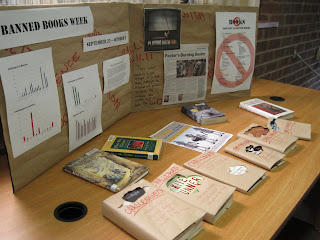 algebra or balance a checkbook until they're legally adults; those are important, yes, but we at the Library also offer a place where people are free to investigate any line of questioning they wish.
That's why Banned Books Week is relevant to the Gallaudet University Library, even though very few, if any, of our books are actually challenged; this is true for most other academic libraries. To learn more about Banned Books Week at the Gallaudet University Library, come in and look at the display table in front of the first-floor entrance by Peet Hall, where Elizabeth Henry's set up a fantastic display of banned books.
Heck, take one home with you if you like.
No, it's not a national holiday. It's actually sort of an awareness campaign that the American Library Association sponsors every year.
Awareness of what, you ask? Of things like the following list of titles:
1. ttyl; ttfn; l8r, g8r (series), by Lauren Myracle
2. And Tango Makes Three, by Peter Parnell and Justin Richardson
3. The Perks of Being A Wallflower, by Stephen Chbosky
4. To Kill A Mockingbird, by Harper Lee
5. Twilight (series) by Stephenie Meyer
6. Catcher in the Rye, by J.D. Salinger
7. My Sister’s Keeper, by Jodi Picoult
8. The Earth, My Butt, and Other Big, Round Things, by Carolyn Mackler
9. The Color Purple, by Alice Walker
10. The Chocolate War, by Robert Cormier
And so things become a bit clearer: These books are, in fact, the top ten most-challenged books of 2009.
It sounds kind of funny: what does "challenging" mean, anyway? What does this have to do with banned books?
A lot, in fact. "Challenge" is a word used to describe the process of requesting that a library remove a book from its shelves for various reasons unrelated to the book's physical condition or currency (how up-to-date it is). In other words, these are books that people want banned -- and these books got the most requests for removal out of all challenged books in the United States last year.
Still sounds kind of vague, huh? After all, look at the list again. And Tango Makes Three? That's a children's book about penguins! The Perks of Being a Wallflower? It's practically a Bible for adolescents and college students who don't quite fit in. To Kill a Mockingbird -- that's a classic! Ditto Catcher in the Rye. My Sister's Keeper kind of makes sense; I've heard that it makes people cry. But The Color Purple? That's another significant classic in 20th-Century American literature.
That's just from the 2009 list. Check out this list of classics that have been banned or challenged at one time or another; there are some real eye-poppers in there, like Winnie-the-Pooh.
Why are they challenged? Luckily, ALA keeps track of the reasons, as reported to the Office for Intellectual Freedom. Here's the same list again, this time with the reasons for each challenge:
1. ttyl; ttfn; l8r, g8r (series), by Lauren Myracle
Reasons: drugs, nudity, offensive language, sexually explicit, unsuited to age group
2. And Tango Makes Three, by Peter Parnell and Justin Richardson
Reasons: homosexuality
3. The Perks of Being A Wallflower, by Stephen Chbosky
Reasons: anti-family, drugs, homosexuality, offensive language, religious viewpoint, sexually explicit, suicide, unsuited to age group
4. To Kill A Mockingbird, by Harper Lee
Reasons: offensive language, racism, unsuited to age group
5. Twilight (series) by Stephenie Meyer
Reasons: religious viewpoint, sexually explicit, unsuited to age group
6. Catcher in the Rye, by J.D. Salinger
Reasons: offensive language, sexually explicit, unsuited to age group
7. My Sister’s Keeper, by Jodi Picoult
Reasons: homosexuality, offensive language, religious viewpoint, sexism, sexually explicit, unsuited to age group, violence
8. The Earth, My Butt, and Other Big, Round Things, by Carolyn Mackler
Reasons: offensive language, sexually explicit, unsuited to age group
9. The Color Purple, by Alice Walker
Reasons: offensive language, sexually explicit, unsuited to age group
10. The Chocolate War, by Robert Cormier
Reasons: nudity, offensive language, sexually explicit, unsuited to age group
So someone doesn't like And Tango Makes Three because it's about a pair of male penguins who raise a child, which might touch on a topic he or she feels is not appropriate for the children who would read it. What happens?
Usually, they go to their library and ask that the library stop making that book available, through means that vary from library to library -- some have forms you can fill out, while others just write down the book title and take it to the person or committee who's responsible for making decisions about challenged books. Then that decision-making entity figures out how to respond to the complaint: Should the book be moved to a more appropriate section? Should we remove it entirely? Or should we do nothing?
Although I don't have statistics immediately to hand, I assume that in the majority of cases, the decision is to do nothing. If you've read even two or three of the books in that list above, you understand why. Yes, all of these complaints are true, but are they reasons to censor these books?
You may have hesitated before answering that last question for yourself. That hesitation is what makes life interesting for some librarians; there's no universal rule that says "This book MUST be removed from shelves if ... " Some libraries toss those complaints right into the trash; it's not their job to control what people can or can't read, regardless of age -- they just make the books available, and the rest is up to the readers. Other libraries rely on their own rules, like "gratuitousness" -- is this violence, language, or sexuality excessive? "Excessive" in whose opinion? Is it one of those things that you'll know when you see it, or is excessive violence quantifiable? How do you justify those kinds of decisions? Still others do pay attention to age-appropriateness; The Chocolate War sounds like a kids' book and might be in the library's catalog as such, but it is most definitely better-suited to teenagers. The gray areas go on and on ...
We don't do this because we think we know better than the people making the requests to remove books; all of this matters, because books that have been banned on moral, philosophical, religious, or political grounds are books that have been censored. Censorship is a bad thing; the First Amendment guarantees the right to express your opinion, and librarians play one of the most important supporting roles for this basic human right in our society. The flipside of the freedom of speech is the freedom to read, something that ALA strongly supports; not only do you have the right to express your opinion, you have the right to gain access to the printed opinions of others. This is called intellectual freedom, the freedom to ask questions and gain answers, and it's one of the most fundamental concepts underlying the establishment of a university. Universities don't just teach high-school kids how to do linear
 algebra or balance a checkbook until they're legally adults; those are important, yes, but we at the Library also offer a place where people are free to investigate any line of questioning they wish.
That's why Banned Books Week is relevant to the Gallaudet University Library, even though very few, if any, of our books are actually challenged; this is true for most other academic libraries. To learn more about Banned Books Week at the Gallaudet University Library, come in and look at the display table in front of the first-floor entrance by Peet Hall, where Elizabeth Henry's set up a fantastic display of banned books.
Heck, take one home with you if you like.
Friday, September 24, 2010
Friday, September 17, 2010
Book review: Under the Dome
Yay, book review! I have to admit that, in this new age of vlogging, I miss being able to write my reviews. You'll have to indulge my (hopefully) charmingly quaint sensibilities today.
I read -- and brace yourselves -- Under the Dome by Stephen King.
What can I say? Although I will admit that I've since moved on from the stage of my life where I thought Stephen King was the Great American Novelist (mostly based on his earlier work and the Dark Tower books), I still can't resist looking through his newest stuff. I read Duma Key last year and actually quite liked it; all his usual motifs were firmly in place, but with the addition of some refreshingly creepy elements that made it a terrific read. I still flash back to his description of seashells grinding under the main character's stilt house on the beach and shudder.
So, of course, with that expectation in mind, I went under the dome.
The basic premise is that a tiny, tiny little town way up in the middle of nowhere, in one of those little states up in the corner of the country, Maine or New Hampshire or somewhere, suddenly finds itself surrounded by an invisible, impenetrable barrier. This is discovered in a spectacularly grisly day, in true King fashion, as people on the road and unaware slam into the barrier at a few dozen miles per hour. The barrier extends up nearly forty thousand feet and closes over the town completely; planes start crashing into it on their descents into Logan Airport in Boston or to the airport in Bangor.
Since the town is so small, everyone knows each other. Also because of the tininess of the community, people's peccadilloes -- and, eventually, dangerous instabilities -- are multiplied enormously, and this is only exacerbated by the sudden erection of this barrier. The military becomes aware of the situation and undertakes several means of punching through it, but fail. The world watches, stunned, as the town discovers itself completely and utterly trapped.
As the days go by, we follow an unusually -- for Stephen King, anyway -- large ensemble of characters as they cope with the difficulties associated with being cut off from the outside world in every way except visibility: They can see what's over there just fine, but there's no way to get there. The ancillary consequences of being parked under a barrier continue to mount as people burn wood to keep warm when they run out of propane and continue to drive cars and trucks around town.
There are two main groups being pitted against one another here: a loose confederation of people -- including a former soldier who finds himself back in service -- who just want to get that barrier down and get out, versus a town selectman with a decidedly fascistic bent and his creepy cadre of local criminal teens, who are deputized and put to work subduing the populace. As the novel goes on, it becomes something far stranger, as the local meth-lab chef gets involved in a surprising way, and people begin to die.
There's plenty of homicide involved -- mostly committed by people you wouldn't expect -- but also suicides as people slowly begin to despair of ever leaving, as well as plain old medical emergencies from the steadily-worsening air and greenhouse-effect heat under the dome. It's all done in King's style, though -- there's plenty of funny stuff stemming from the absurdities brought about by the situation, people fall in love, and young kids have their hands in saving the town ... sort of.
Truth be told, the ending isn't very happy. It's also incredibly violent, sparked by a nuclear blast set off by the military just outside the dome to no avail.
In general, it's a pretty interesting study of one man's consideration of what happens to people when they find themselves backed into a corner by something they can't come close to comprehending; some people turn to help others, while others turn to help themselves. When the latter also hold positions of power, things can get very ugly indeed, and they do so in this novel in scarily believable ways. The slope is slippery, King seems to be saying, so watch your footing. It's surprisingly free of most of his usual tropes (except things like psychic kids, one flat-out loony, and endearingly rural surnames), so it's a pretty refreshing thing to get from him.
It's not an intellectual book in any way. It's Stephen King. However, this same fact also means it's a tremendously entertaining book.
Tuesday, September 14, 2010
Constitution Day, new resources, staplers
A few quick announcements ...
Constitution Day resources are now available
If you haven't seen the news in the Announcements section of our home page, we've posted a Web page with information about this year's Constitution Day, on Friday, Sept. 17. This year, we're celebrating the Second Amendment, otherwise known as the "You'll have to pry my sawed-off shotgun from my cold, dead hands" Amendment. There's actually a lot more to the Amendment than what you hear from the NRA and from the left; the Founding Fathers had very real concerns that underpinned the choice to include this amendment in the Bill of Rights. You can learn more about that by going here.
A bunch of other new resources are now available
We've added a few new things to our ever-expanding list of offerings! A new page will appear on our Web site by the end of the week with more comprehensive explanations, but in a nutshell, here's what's new:
Staplers
They're on our minds. More details later.
I'm still working on the Deaf Copy 1 tour. Also, book review this Friday! And it's not gonna be a vlog neither ...
Constitution Day resources are now available
If you haven't seen the news in the Announcements section of our home page, we've posted a Web page with information about this year's Constitution Day, on Friday, Sept. 17. This year, we're celebrating the Second Amendment, otherwise known as the "You'll have to pry my sawed-off shotgun from my cold, dead hands" Amendment. There's actually a lot more to the Amendment than what you hear from the NRA and from the left; the Founding Fathers had very real concerns that underpinned the choice to include this amendment in the Bill of Rights. You can learn more about that by going here.
A bunch of other new resources are now available
We've added a few new things to our ever-expanding list of offerings! A new page will appear on our Web site by the end of the week with more comprehensive explanations, but in a nutshell, here's what's new:
- Art Full Text
- JSTOR Arts & Sciences I (basically, we expanded our JSTOR subscriptions; you won't see it as a discrete collection because it's simply been added to the pool of articles already available)
- Encyclopedia of Language and Linguistics, an electronic encyclopedia available through ALADIN Discovery
- Several books donated by the Nippon Foundation about Japanese art, history, and culture. If you're interested in Japan in general, keep an eye out!
Staplers
They're on our minds. More details later.
I'm still working on the Deaf Copy 1 tour. Also, book review this Friday! And it's not gonna be a vlog neither ...
Friday, September 10, 2010
Subscribe to:
Posts (Atom)

 Posts

